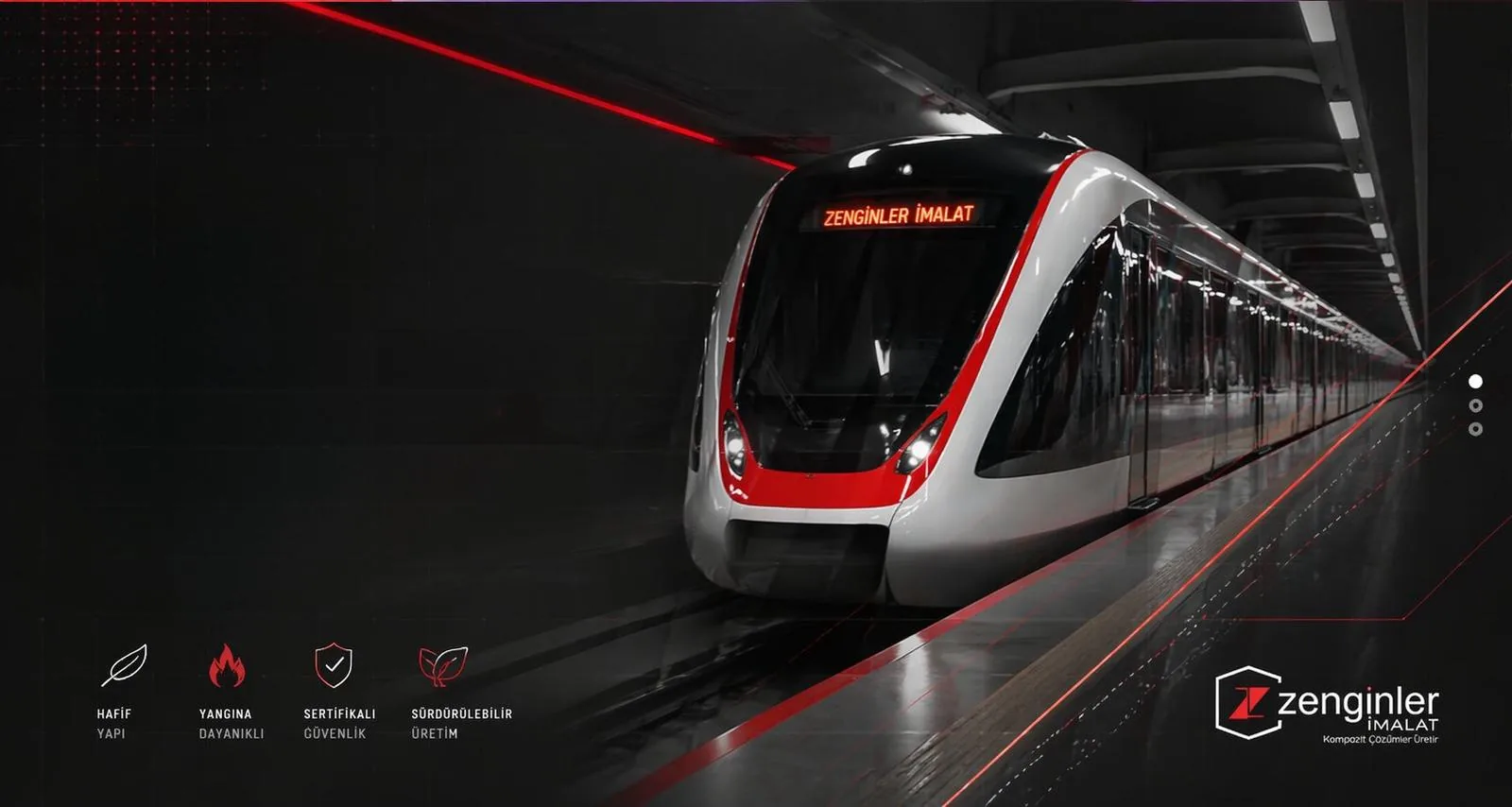

RAIL SYSTEMSCOMPONENT PROGRAMME
Glass-fibre reinforced composite interior and exterior components for multiple units, light rail vehicles, locomotives and passenger coaches. Engineered, moulded, finished and painted under one roof in Sakarya, Türkiye.
NEARLY FIFTY YEARS
IN COMPOSITES
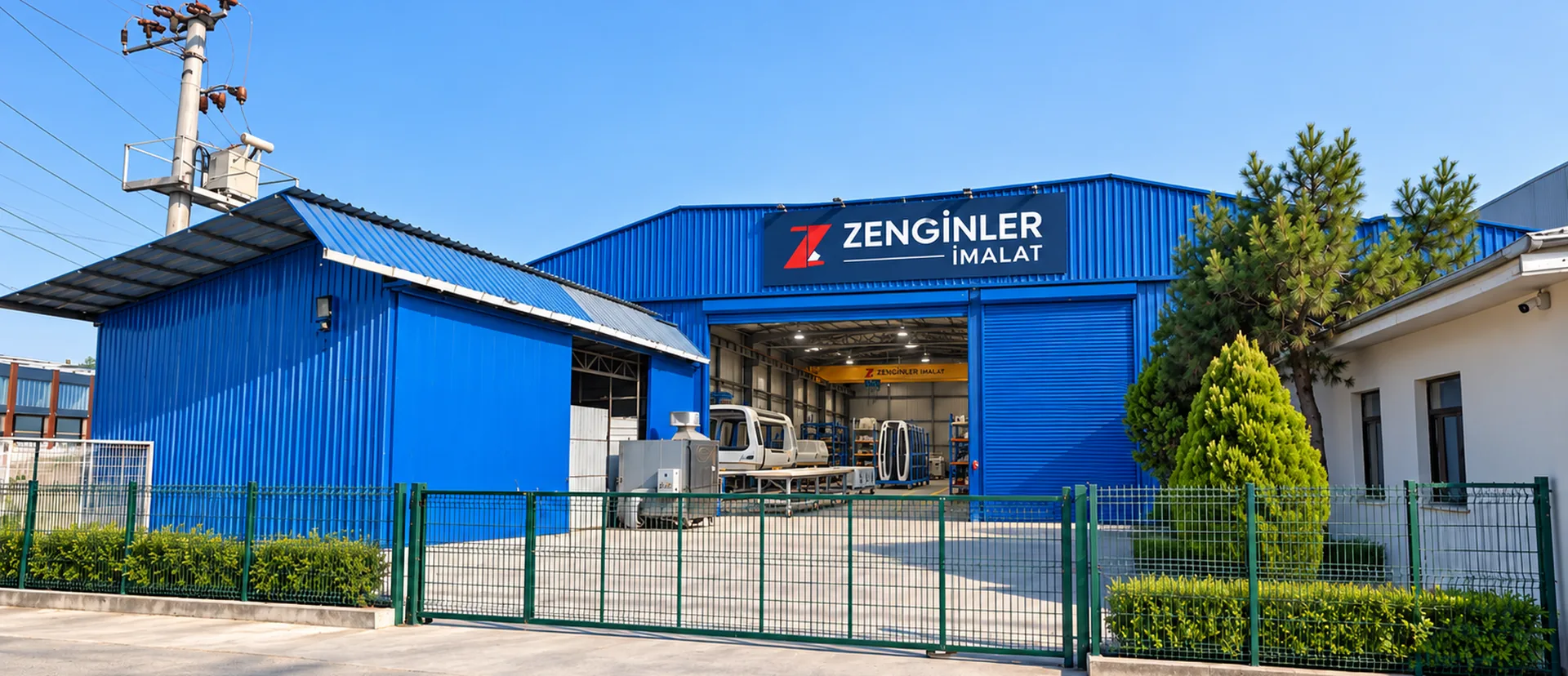
Zenginler İmalat was founded in 1977 by İbrahim Zengin as a composite repair workshop. Series production began in the early 1980s and our first proprietary design was manufactured in 1984. Since 1988 we have supplied original equipment manufacturers as a tier supplier, and today we operate from our own 3,750 m² plant in Erenler, Sakarya.
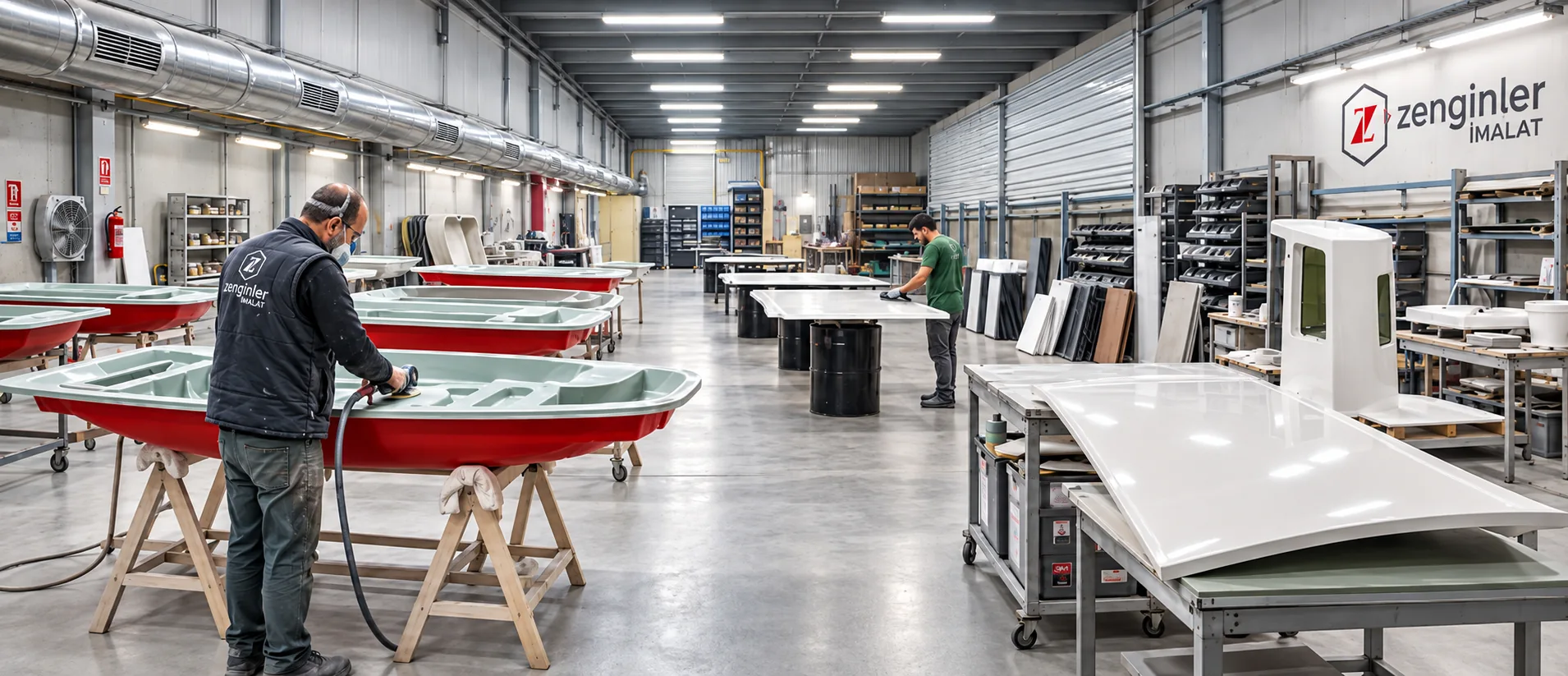
For nearly five decades, we have widened our process portfolio step by step — hand lay-up, vacuum infusion, resin transfer moulding, pultrusion and spray-up — so that each component can be produced with the method that best suits its geometry, surface requirement and annual volume. Moulding, robotic trimming, finishing and wet painting are all carried out in-house, which keeps lead times short and quality traceable from the mould to the delivered part.
Vision
To diversify our production techniques so that we can offer more integrated composite solutions to our customers.
Mission
To make life easier through innovative composite products and to become the solution partner our customers rely on.
MILESTONES
1977 — TODAY
PRODUCTION
TECHNOLOGIES
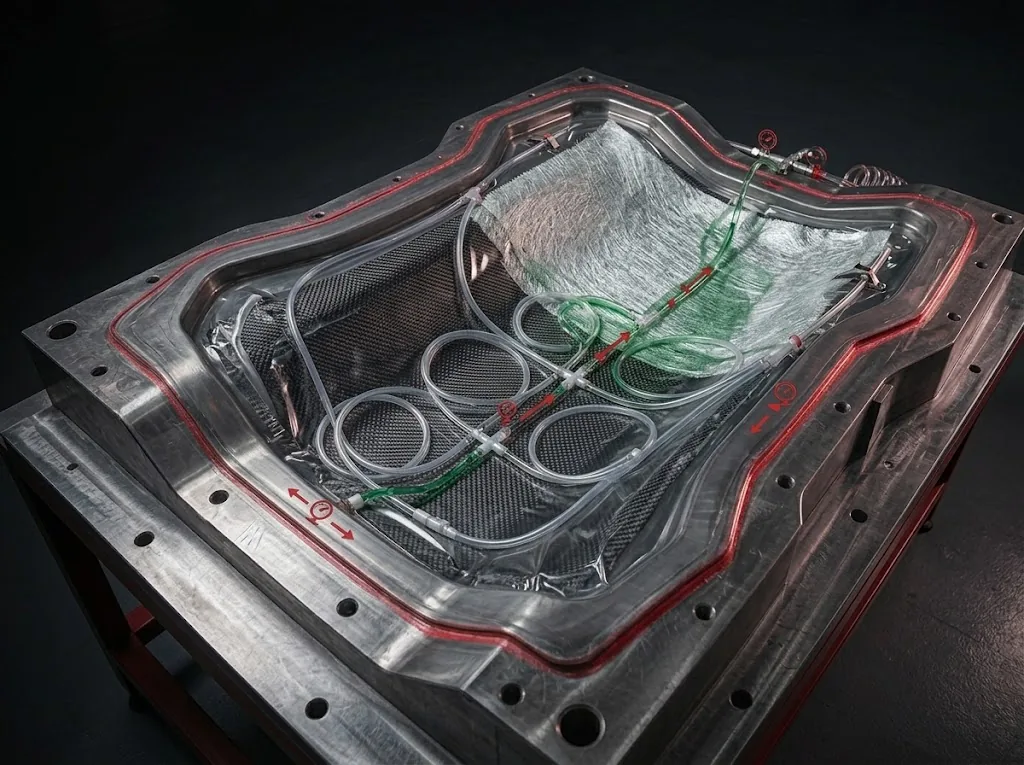
Five complementary processes let us match the method to the part.


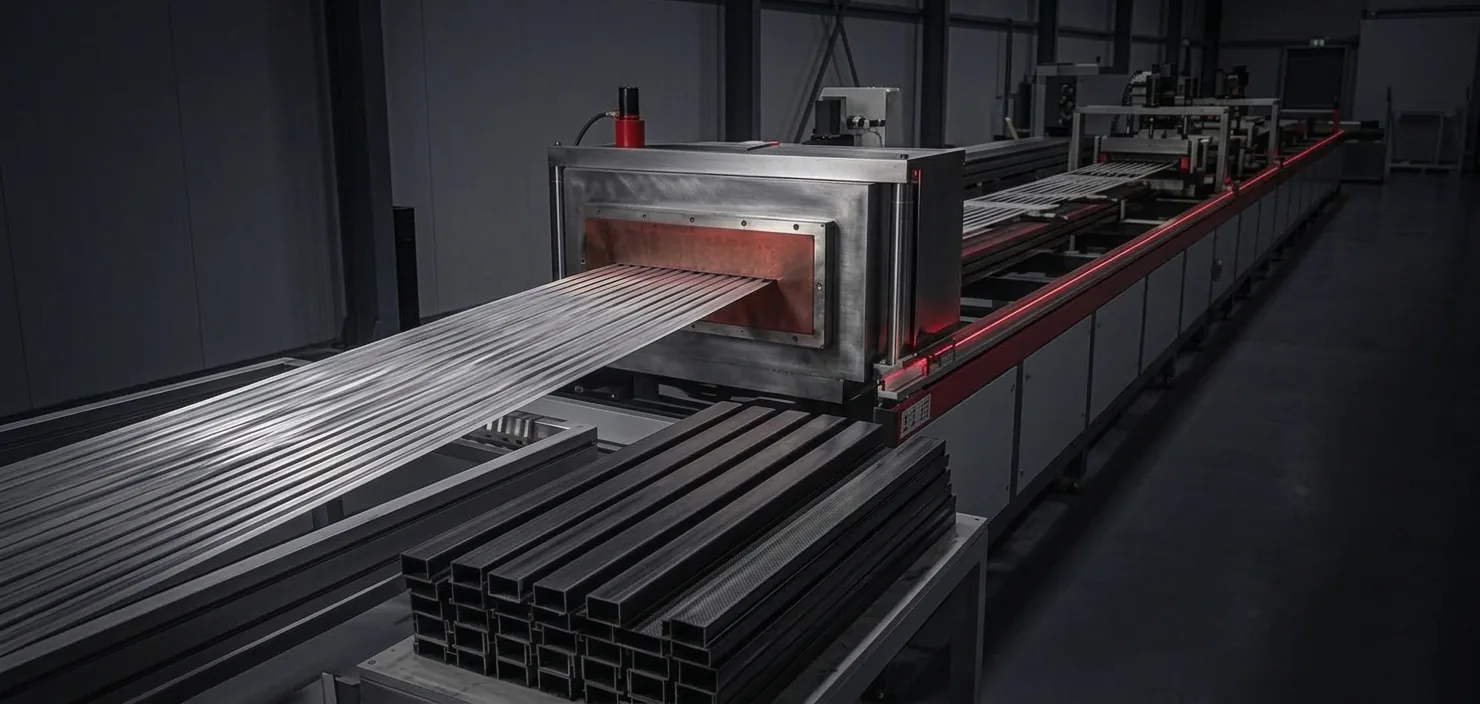
05 · Spray-Up & Robotic Trimming
Introduced in 2019, our spray-up line and robotic trimming cell raise output and repeatability on higher-volume programmes, holding trim and drilling tolerances consistently across a production run.
FROM MOULD
TO PAINTED PART
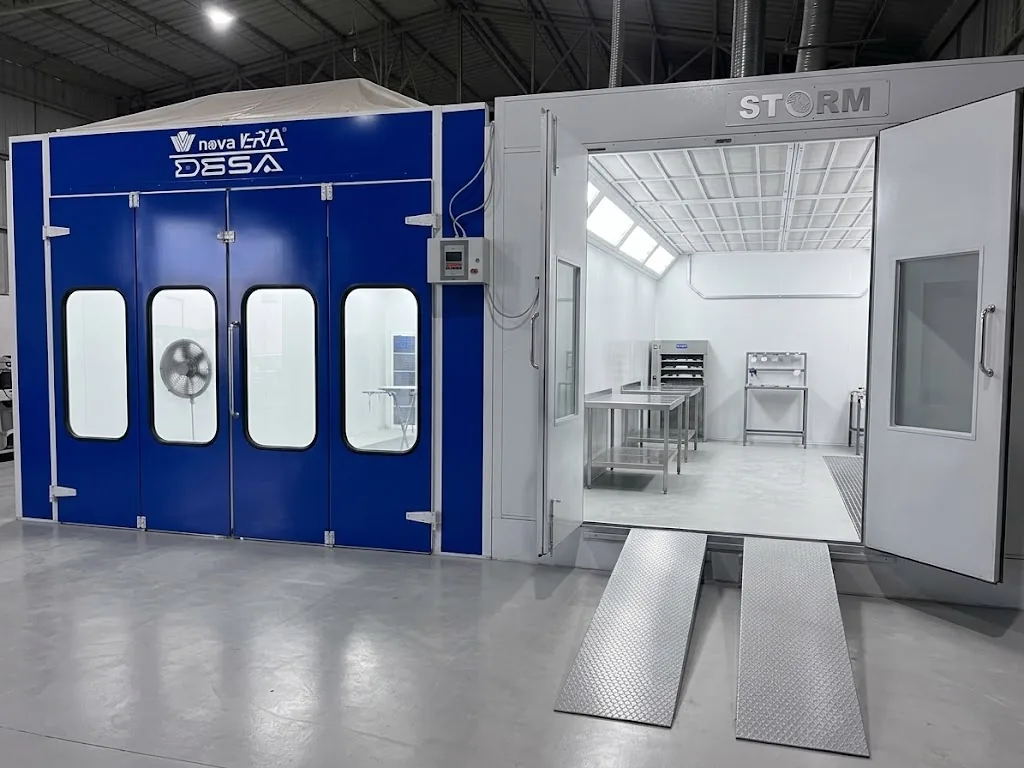
Pattern making, moulding, trimming, finishing and painting are performed in-house. A single point of responsibility from first sample to series delivery.
Pattern & Mould Making
Product models and production moulds are designed and built in-house, shortening the path from drawing to first article.
Levelling & Finishing
A dedicated levelling department prepares surfaces to the flatness and finish quality required for visible vehicle parts.
Robotic Trimming
Programmed trimming and drilling holds contour and hole positions repeatably across the whole batch.
Wet Painting
Parts leave the plant painted to the customer's colour and gloss specification, ready for assembly.
RAIL
SYSTEMS
Rail is where our composite experience concentrates. We produce interior and exterior GRP components for multiple units, light rail vehicles, locomotives and passenger coaches — as a tier supplier to Turkish rolling stock manufacturers since the 1990s.
Light
Substantially lower mass than steel assemblies, reducing energy per vehicle-kilometre.
Fire-Retardant
Resin systems selected to meet the fire and smoke specification of the programme.
Corrosion-Resistant
No rust, no galvanic issues — an advantage over the full service life of the vehicle.
Design Freedom
Complex curvature and part consolidation that sheet metal cannot deliver economically.
EXTERIOR
COMPONENTS
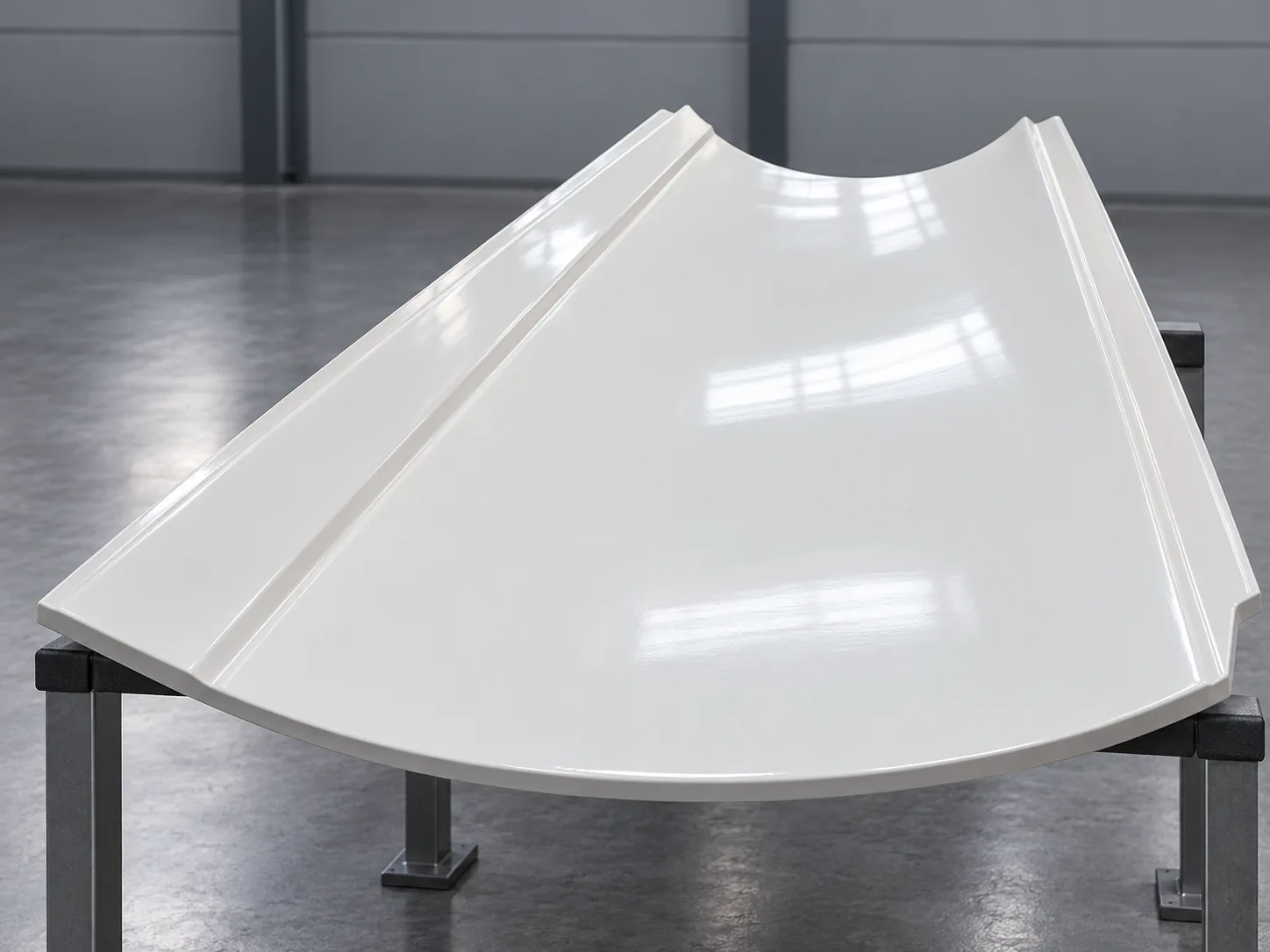
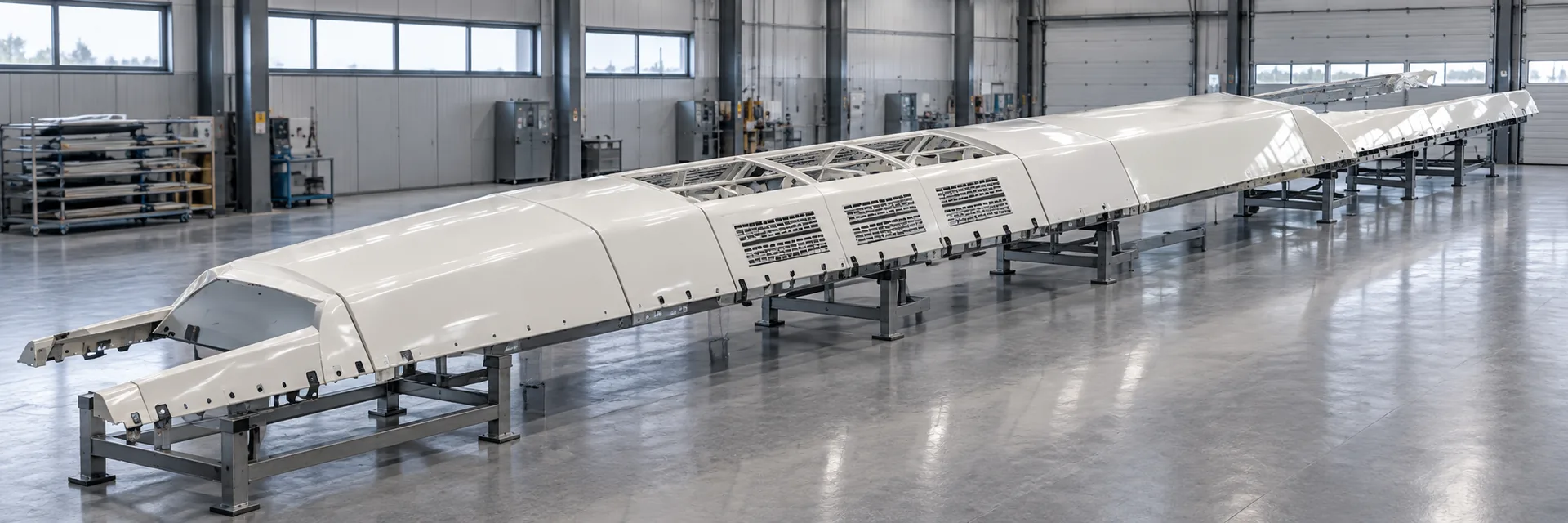
Large-format bodyshell parts produced by hand lay-up and vacuum infusion, trimmed robotically and delivered painted.
- Front mask and cab shell
- Rear body shell
- Side exterior cladding panels
- Pantograph fairing
- Door surround claddings
- Underframe protection panels
- Bogie covers
- Cable ducts and channels
- Roof and upper carriage cladding
- Equipment and turbine housings
INTERIOR
COMPONENTS
Visible passenger-compartment parts. RTM is our route wherever both faces must leave the mould finished; vacuum infusion is used for the large, lightly curved panels.
- Interior wall and ceiling panels
- Ceiling door frames and surrounds
- Window modules and trim panels
- Passenger seat shells
- Driver console
- Partition and divider panels
- Toilet modules — complete WC cubicles
- WC floor panels
- Floor covering carriers
- Luggage rack bodies
- Lighting duct covers
- Dummy panels
Sanitary Modules
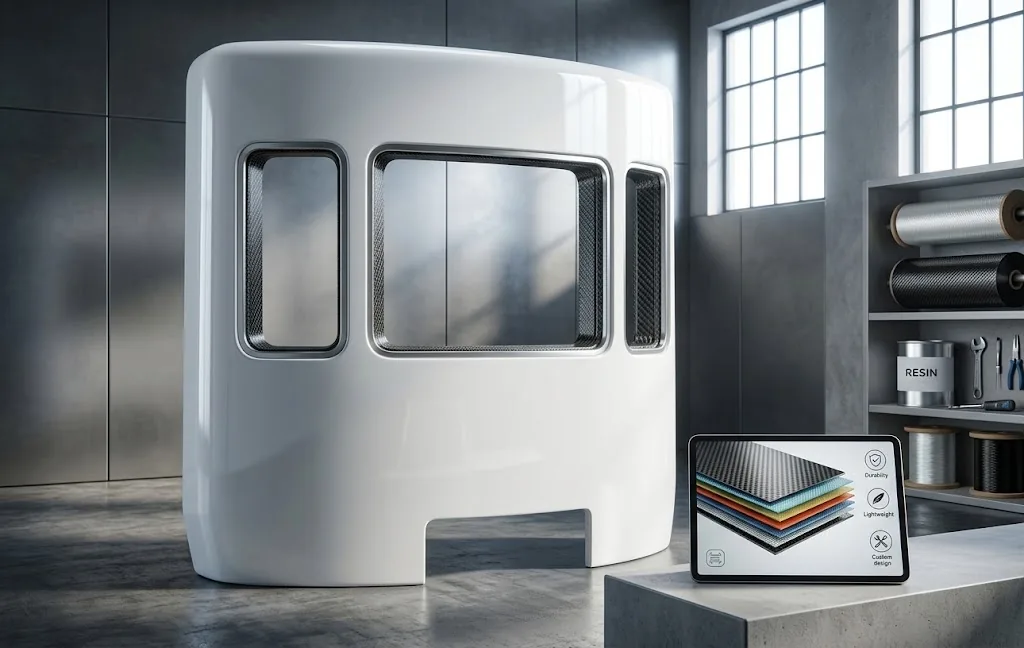
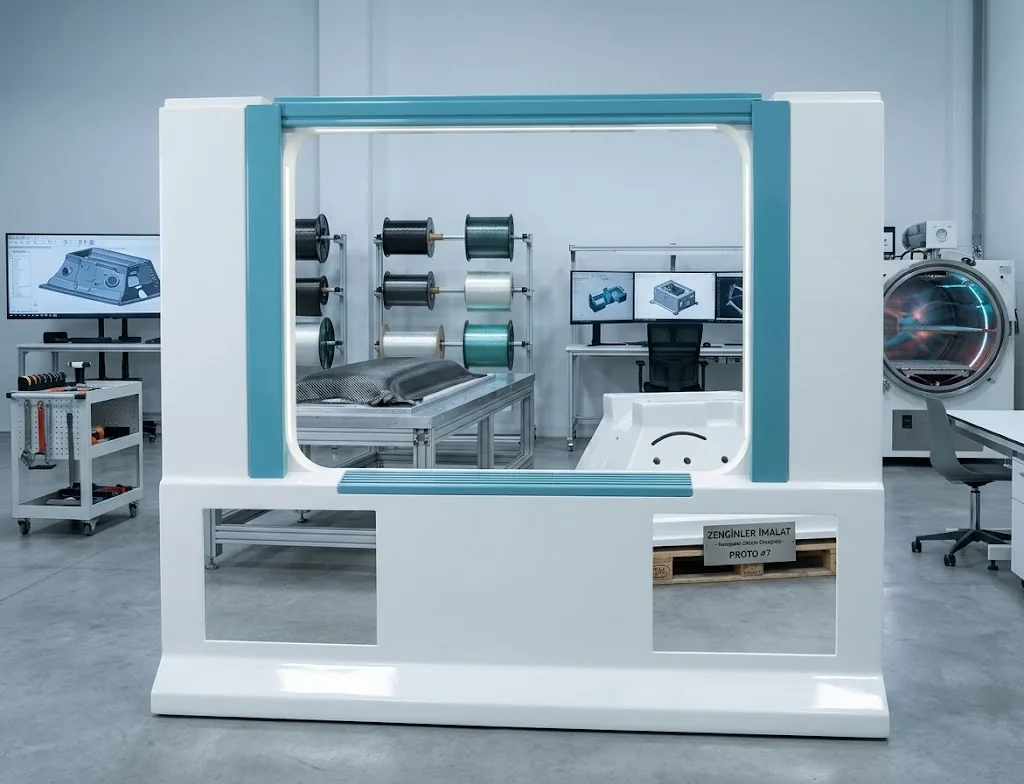
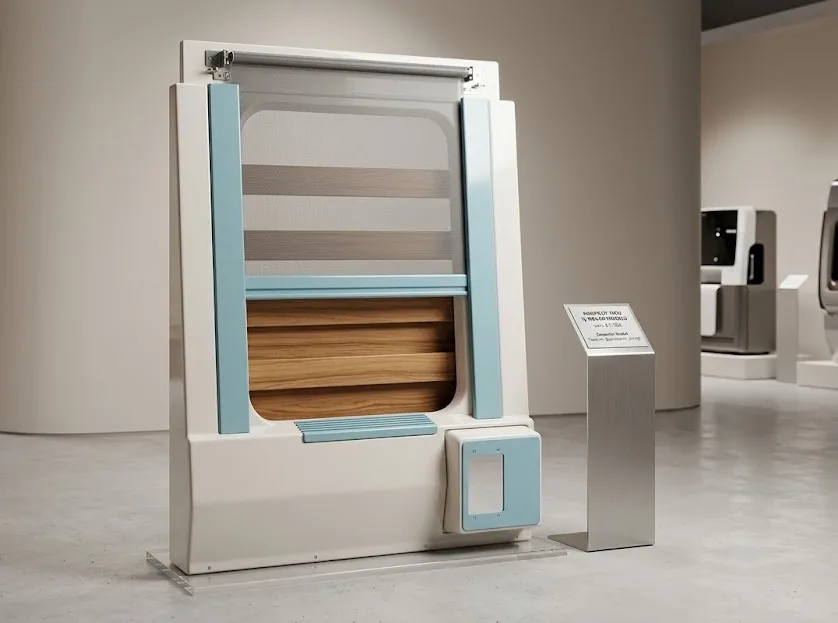
Complete composite WC cubicles, floor panels and water tank assemblies are a long-running part of our rail programme — see page 09. The same moulding and finishing route is used for our modular composite shower cabin — a self-contained unit with a seamless, easily cleaned surface.
SANITARY
MODULES
Complete composite WC cubicles delivered as a single unit — shell, lining, fittings and water system assembled and function-tested before dispatch.
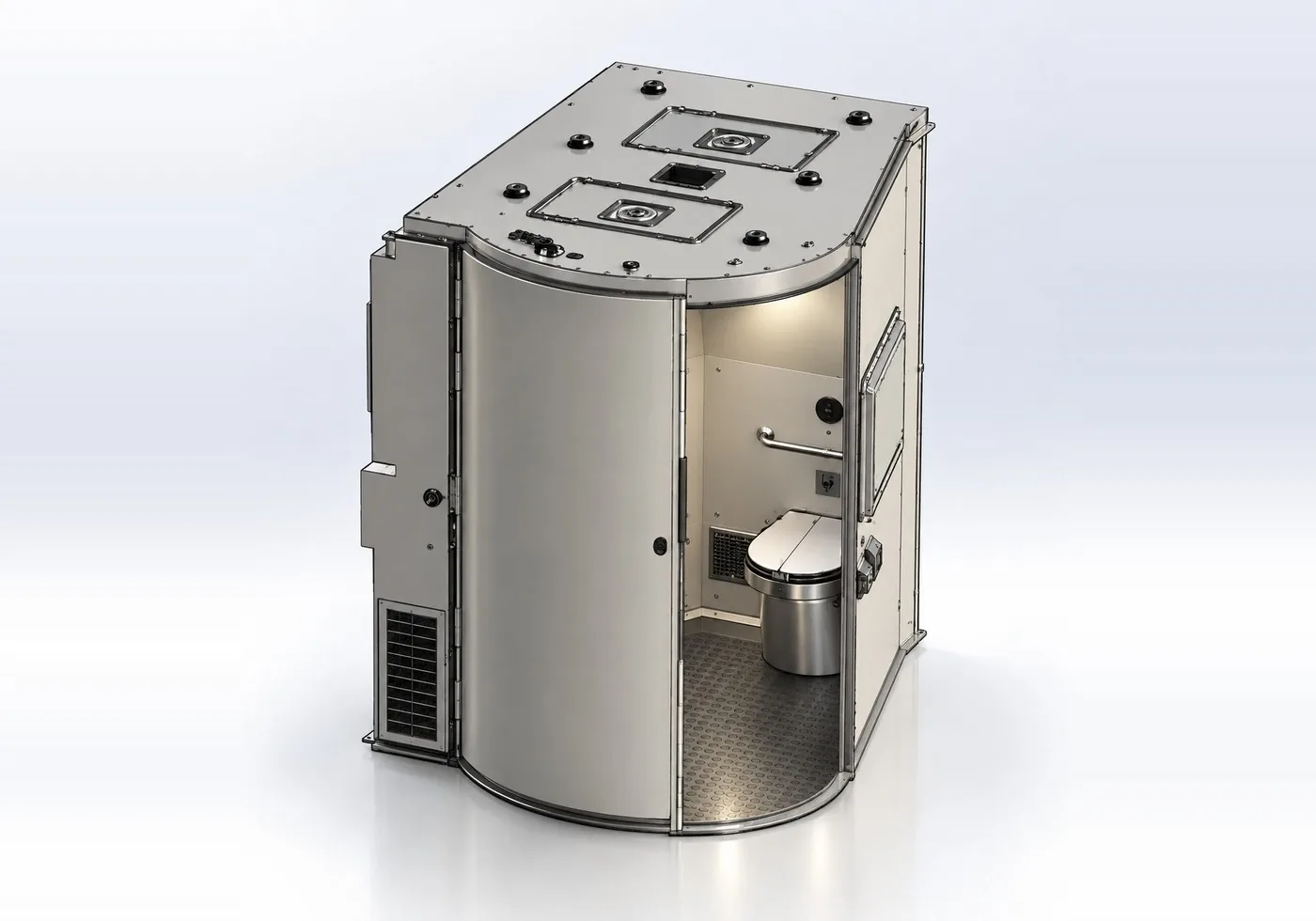
Self-contained cubicle delivered as one unit: curved composite sliding door, seamless interior lining, grab rail, vacuum toilet, anti-slip floor and integrated ventilation. Service hatches in the roof give access to the tanks without entering the cubicle.
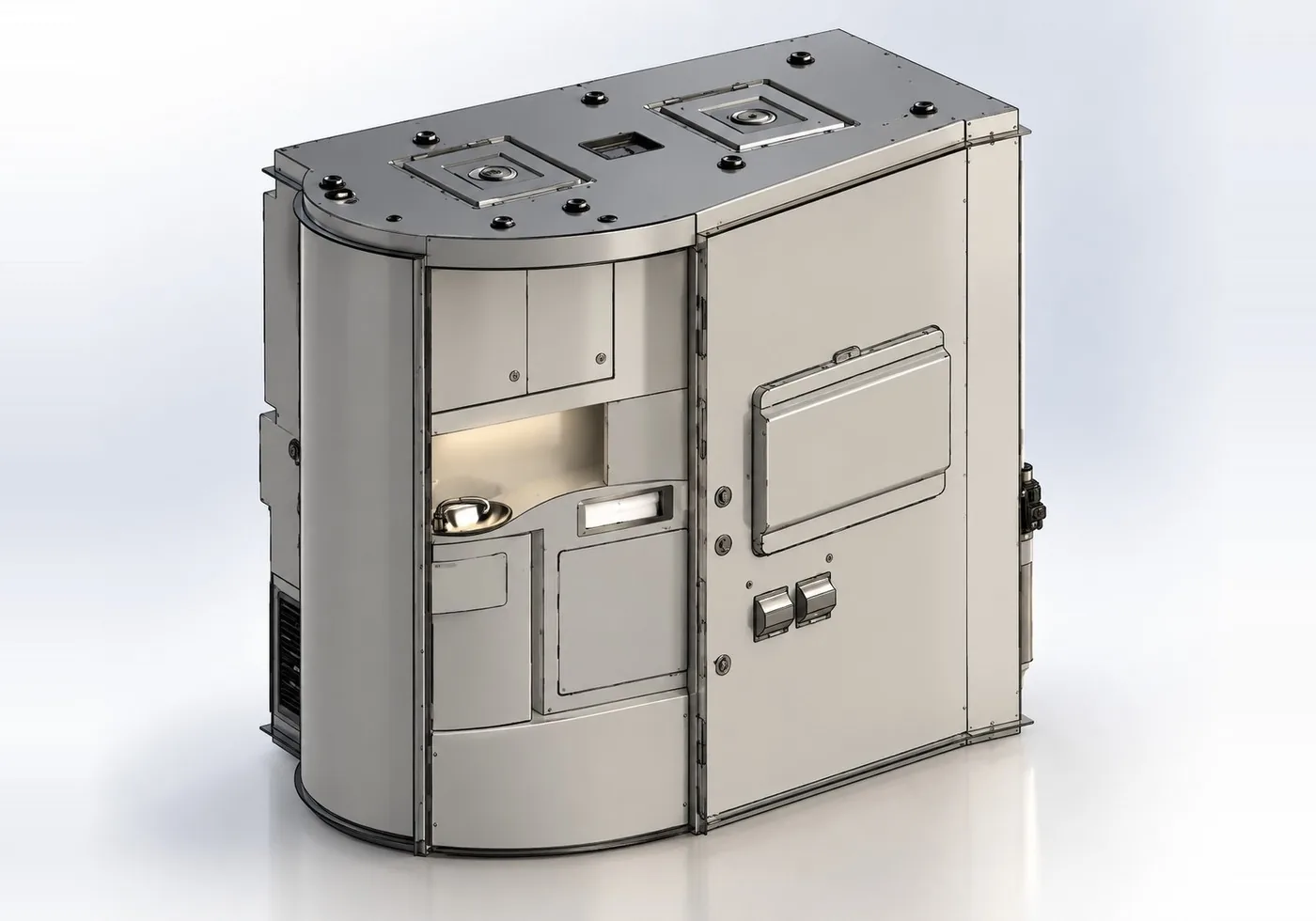
The same module from the washbasin side: moulded basin recess, soap and paper dispensers, waste flap, and a lockable service door opening onto the water and electrical equipment behind the lining.
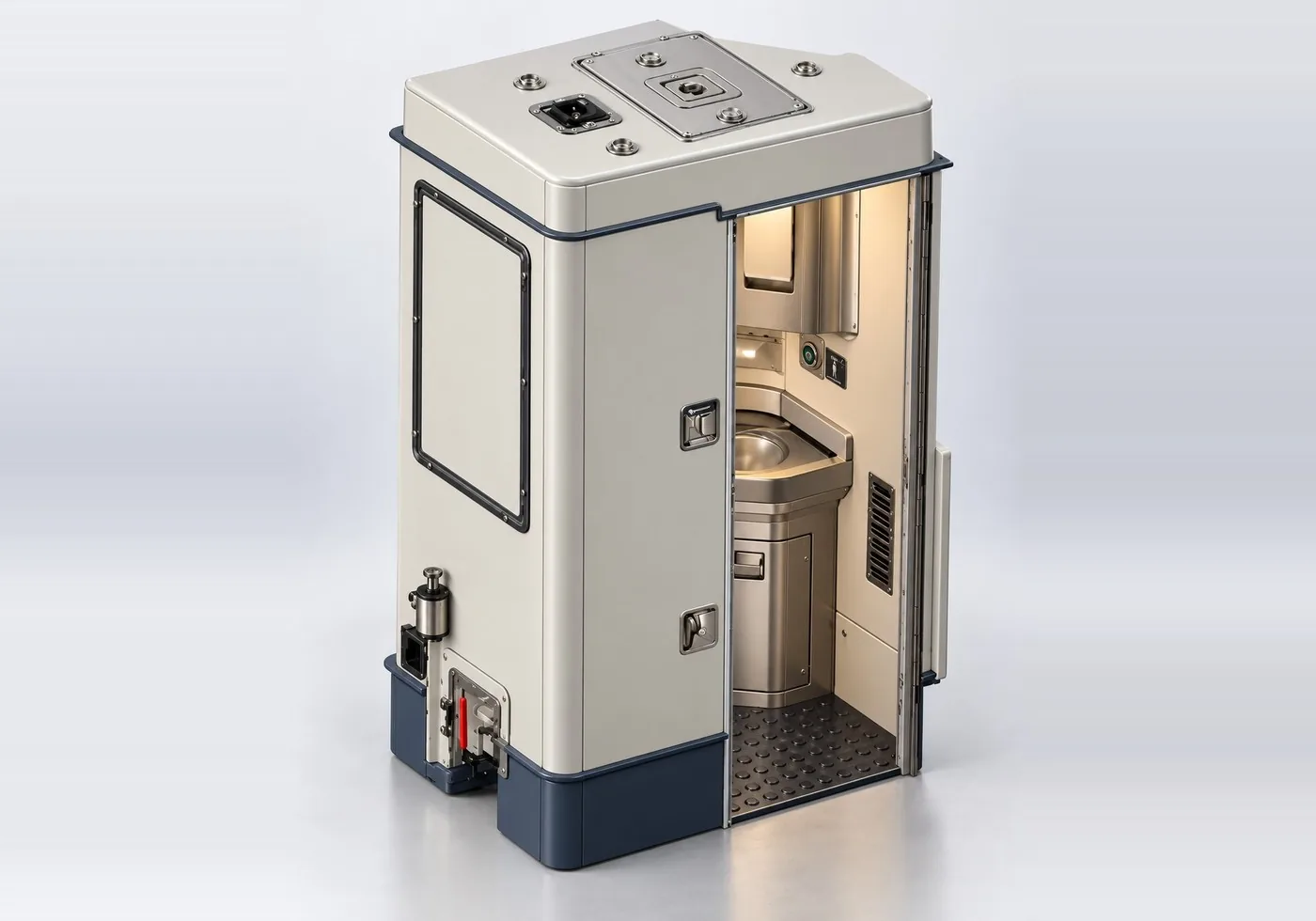
Narrow-footprint version for regional and suburban vehicles. Painted composite outer shell with coloured plinth and trim in the customer livery; filling, drain and service connections brought out to the base.
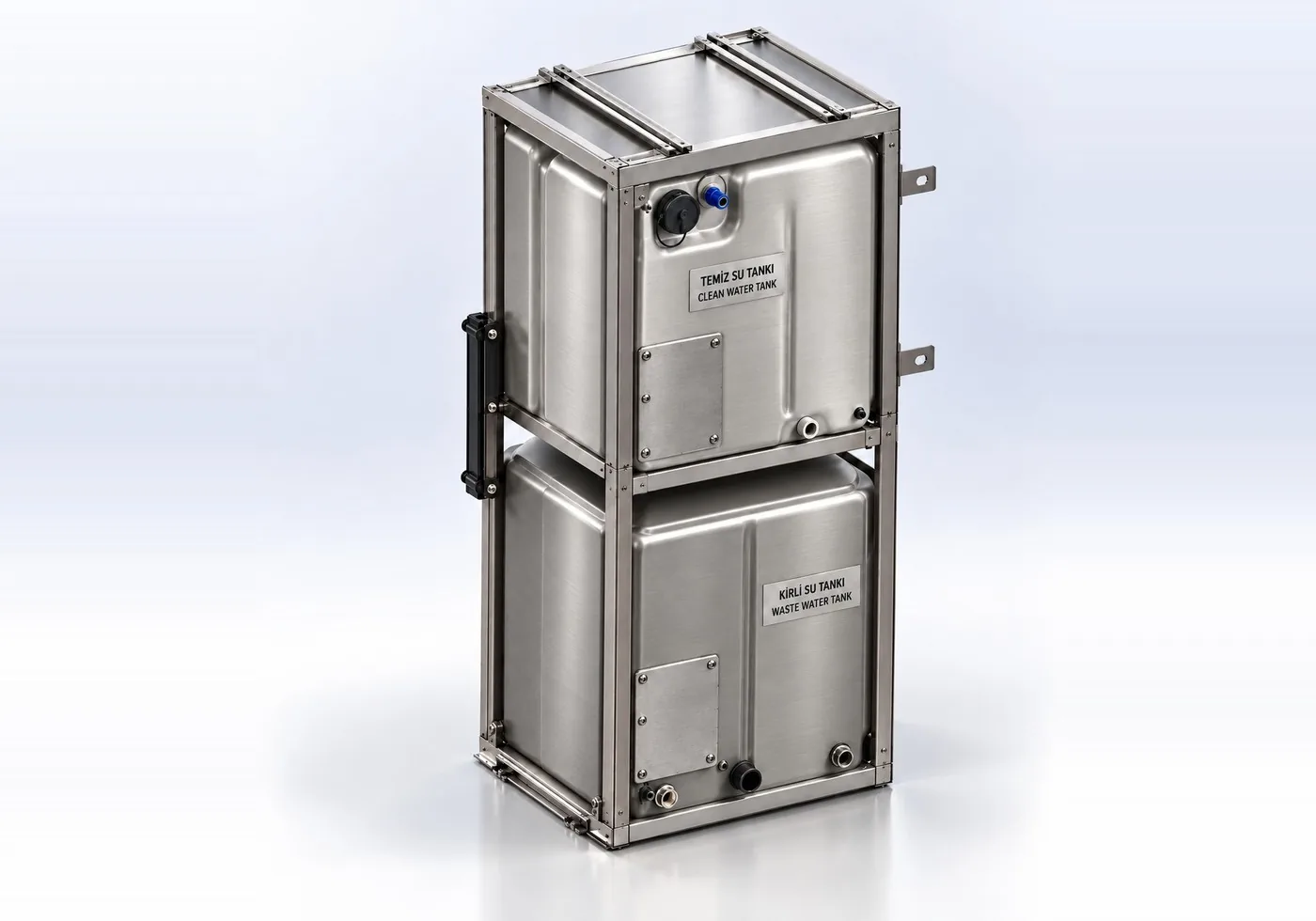
Clean and waste water tanks stacked in a common stainless steel frame, with fill, drain and level connections prepared. Installed under the cubicle floor or in the underframe as one assembly.
FIRE
PERFORMANCE
Our painted glass-fibre laminate is classified to EN 45545-2 at requirement set R1 and meets the limits of all three hazard levels — HL1, HL2 and HL3.
No. 304218 · 23 September 2024
| Parameter | Test method | HL3 limit | Result |
|---|---|---|---|
| MARHE | EN ISO 5660-1 | max. 60 kW/m² | 59.73 |
| Ds(4) | EN ISO 5659-2 | max. 150 | 101.13 |
| CITG | EN ISO 5659-2 | max. 0.75 | 0.68 |
| VOF4 | EN ISO 5659-2 | max. 300 | 183.44 |
| CFE | EN ISO 5658-2 | min. 20 kW/m² | 27.47 |
Tested laminate
Fire-retardant polyester resin and glass reinforcement behind a fire-retardant gel coat, finished with a flame-retardant acrylic-polyurethane primer and topcoat. Mean thickness 3.12 mm, 4.88 kg/m². Three specimens per test method.
Where R1 applies
Interior surfaces, product numbers IN1A to IN14, EX4A and F5: vertical and downward-facing interior surfaces, surfaces inside voids, outer faces of equipment housings, luggage areas, the driver's desk, window frames, air ducts and passenger information devices.
Accreditation
Tested and classified by TSE, Construction Materials Fire and Acoustics Laboratory, accredited by TÜRKAK to EN ISO/IEC 17025 under AB-0001-T. TÜRKAK is a signatory to the EA MLA and the ILAC MRA, so these reports are recognised across Europe. Supporting test reports 304143, 304158 and 304180. This is a reaction-to-fire classification, not a type approval.
LAMINATE
BUILD
The exact build that carries our EN 45545-2 classification. Fire performance is a property of the whole laminate, so the specification is held fixed across the series.
Build, outside in
Measured
Test programme — TSE, 23 September 2024
| Report | Standard | Scope |
|---|---|---|
| 304143 | TS EN ISO 5658-2 | Lateral flame spread — CFE |
| 304158 | TS EN ISO 5659-2 | Smoke density and toxicity — Ds(4), VOF4, CITG |
| 304180 | TS ISO 5660-1 | Heat release, cone calorimeter — MARHE |
| 304218 | TS EN 45545-2 | Reaction-to-fire classification — R1, HL1 / HL2 / HL3 |
Why the build is locked
The classification applies to product built to this specification. A change of resin, gel coat, reinforcement, paint system or thickness invalidates it, so any customer-driven change is re-qualified before series release. Mounting condition as classified: fixed bare, without adhesive, to a substrate classified at least A2-s1,d0, mechanically with metal fasteners or unfastened.
MANAGEMENT
SYSTEMS
Quality, environmental and occupational health and safety management systems, certified by QA Technic International, accredited by IAS under MSCB-208.
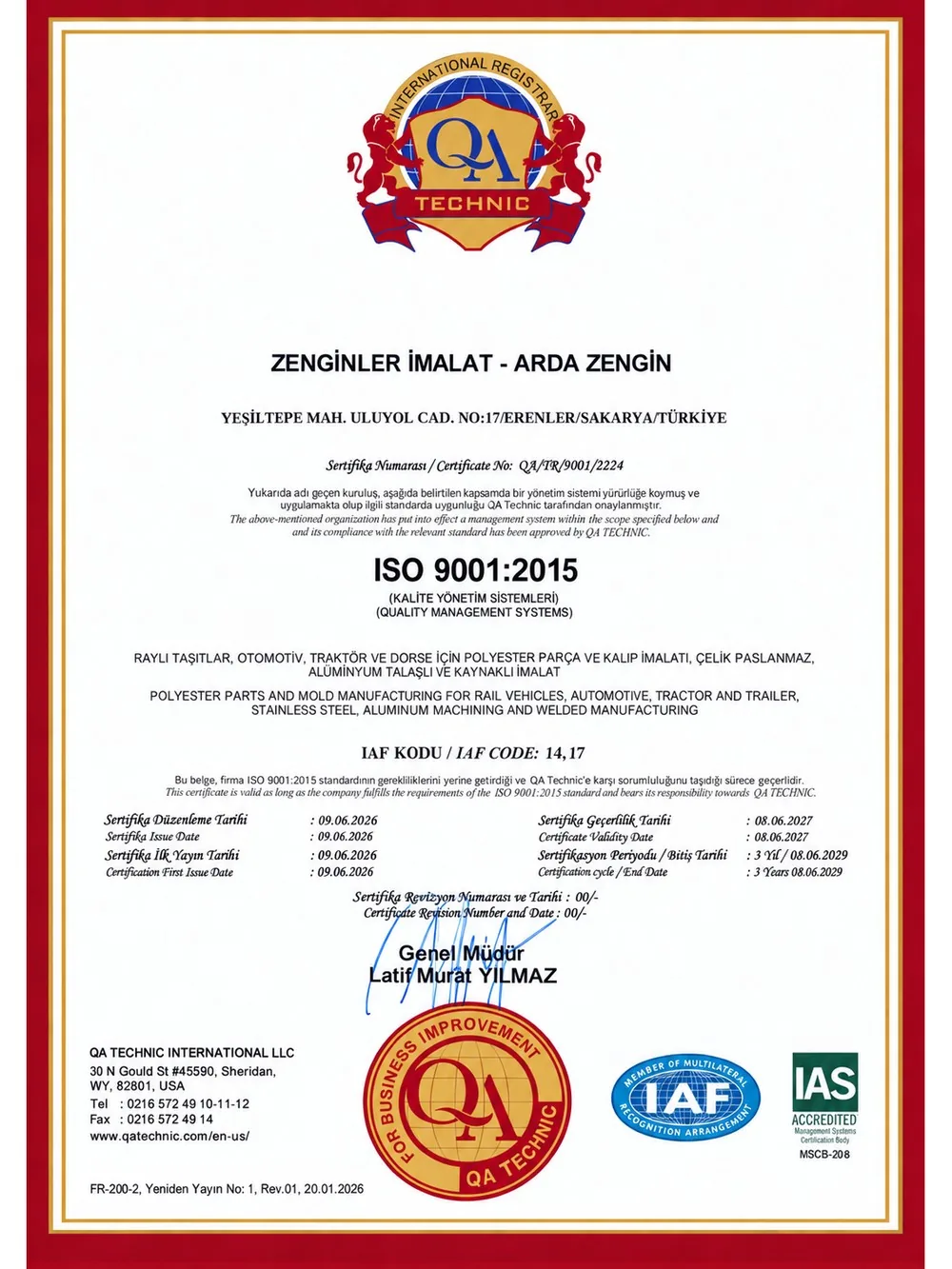
Valid to 08.06.2027
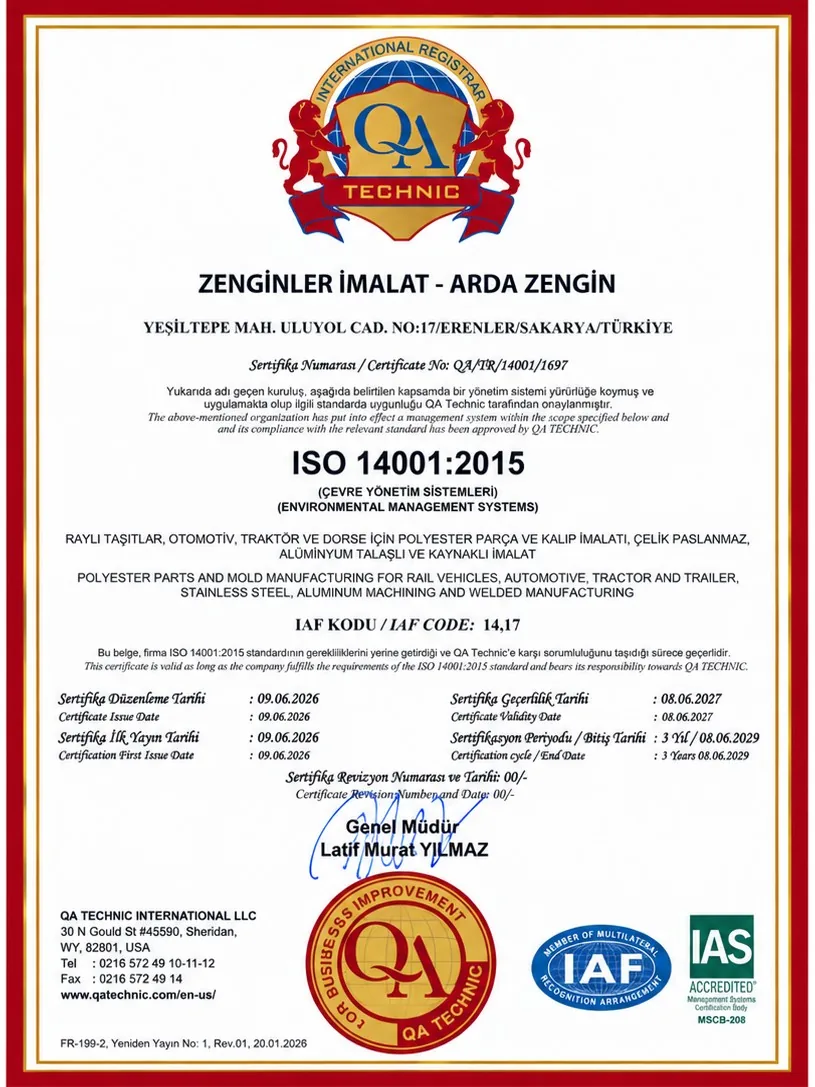
Valid to 08.06.2027
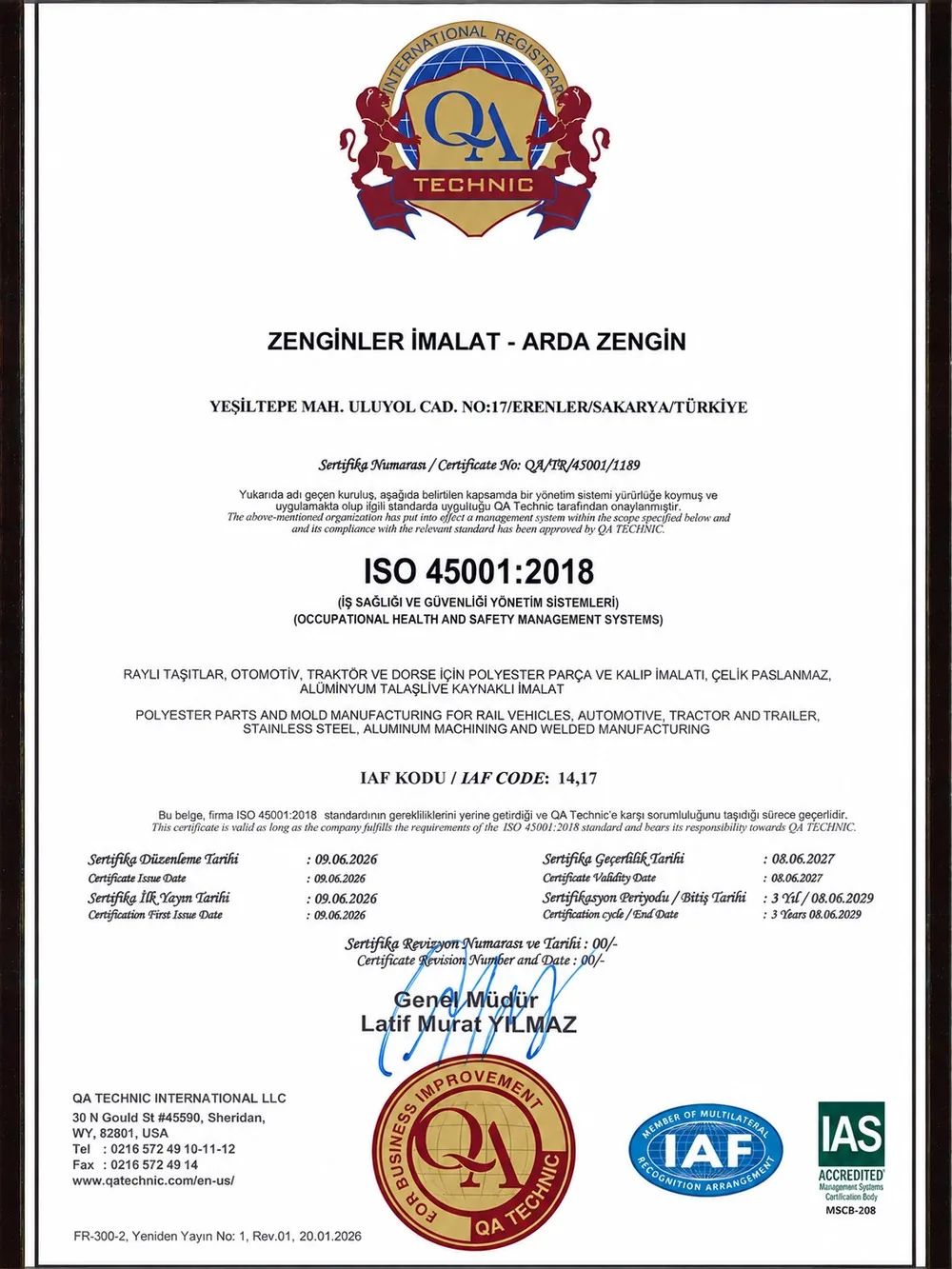
Valid to 08.06.2027
Certified Scope
Polyester parts and mould manufacturing for rail vehicles, automotive, tractor and trailer; stainless steel and aluminium machining and welded fabrication. IAF code 14, 17. Certification cycle to 08.06.2029.
Certification Body
QA Technic International, accredited by IAS under MSCB-208. IAS is a signatory to the Global Accreditation Cooperation (Global ACI) Multilateral Recognition Arrangement. Certificates issued 09.06.2026, with annual surveillance audits.
Documents on Request
The full EN 45545-2 classification report (304218), the three underlying TSE test reports (304143, 304158 and 304180) and all three ISO certificates are available as signed PDFs. Ask us at the stand or write to info@zenginlerimalat.com.
RAIL PROGRAMMES
WE SUPPLY
Selected rolling stock programmes for which Zenginler İmalat has produced composite components as a tier supplier.
| Customer | Components supplied |
|---|---|
| TÜRASAŞ | Vehicle interior trim panels · toilet cubicles · dummy panels · upper carriage cladding panels |
| TÜLOMSAŞ | Turbine housings · side panels and further bodyshell components |
| TÜVASAŞ | Side panels · WC floor panels · fire-retardant electrical distribution panels |
| Hyundai Eurotem | Composite components for rolling stock programmes |
| Otokar | Vehicle body and interior components |
How we work with OEMs
We come in at the drawing, take on pattern and mould making, produce the first article for approval and then run the series. Because trimming, finishing and painting stay in-house, changes during qualification are absorbed quickly and the part arrives assembly-ready.
Customer-specific design work is supported: existing metal assemblies can be redesigned as consolidated composite parts, reducing component count, mass and assembly time.
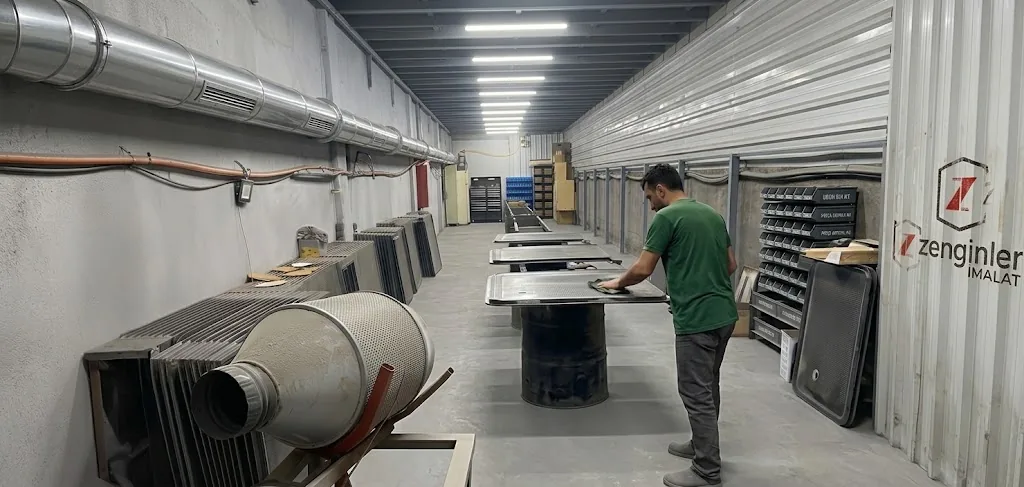
ASSEMBLY-READY PART — ALL UNDER ONE ROOF.
WHY COMPOSITE
FOR ROLLING STOCK
Mass Reduction
GRP assemblies weigh substantially less than the equivalent steel fabrication. Lower vehicle mass means lower traction energy, less track wear and more payload within the same axle load.
Fire and Smoke Behaviour
Resin systems, reinforcements and gelcoats are selected to the fire and smoke specification of each programme — as already applied in the fire-retardant electrical distribution panels we supply.
Corrosion Resistance
No rust, no galvanic coupling and no protective coating cycle. A decisive advantage for underframe, bogie area and sanitary compartments over a thirty-year service life.
Part Consolidation
Ribs, mounting bosses, cable routing and sealing faces are moulded in. One composite part often replaces a welded assembly of many sheet-metal pieces plus its fasteners.
Design Freedom
Double curvature, deep draws and generous radii cost no more in composite than a flat panel. Vehicle styling is not constrained by press tooling limits.
Tooling Economics
Composite moulds cost a fraction of steel press tools, which makes the process viable for the small and medium batch sizes typical of rolling stock.
Surface Quality
Closed-mould RTM delivers two finished faces; in-house wet painting delivers the part in the customer's final colour and gloss, ready to fit.
Maintenance & Repair
Damage can be repaired in situ by laminating rather than by replacing a whole assembly — the discipline this company was founded on in 1977.
OTHER SECTORS
WE SERVE
The same processes, moulds and finishing lines serve six further industries. Experience transfers directly between them — a fire-retardant panel developed for a coach interior is the same discipline as a bus interior or a marine bulkhead.
Automotive
Cab, body and interior components for trucks, buses and electric vehicles. Front masks, spoilers, bumpers and trim.
Energy
High-strength pultruded profiles and housings for wind, solar and grid infrastructure applications.
Construction
Corrosion-resistant façade panels, cassettes, insulation panels and infrastructure ducting.
Machinery
Cabs, guards and enclosures for tractors, construction machinery and industrial equipment.
Marine & Yacht
Hull, deck and fitting components engineered for permanent exposure to salt water.
Caravan & Modular
Caravan equipment, shower cabins, modular sanitary units and custom composite products.
REFERENCES
& CONTACT
Companies for which Zenginler İmalat has produced composite components.
Since 1977