
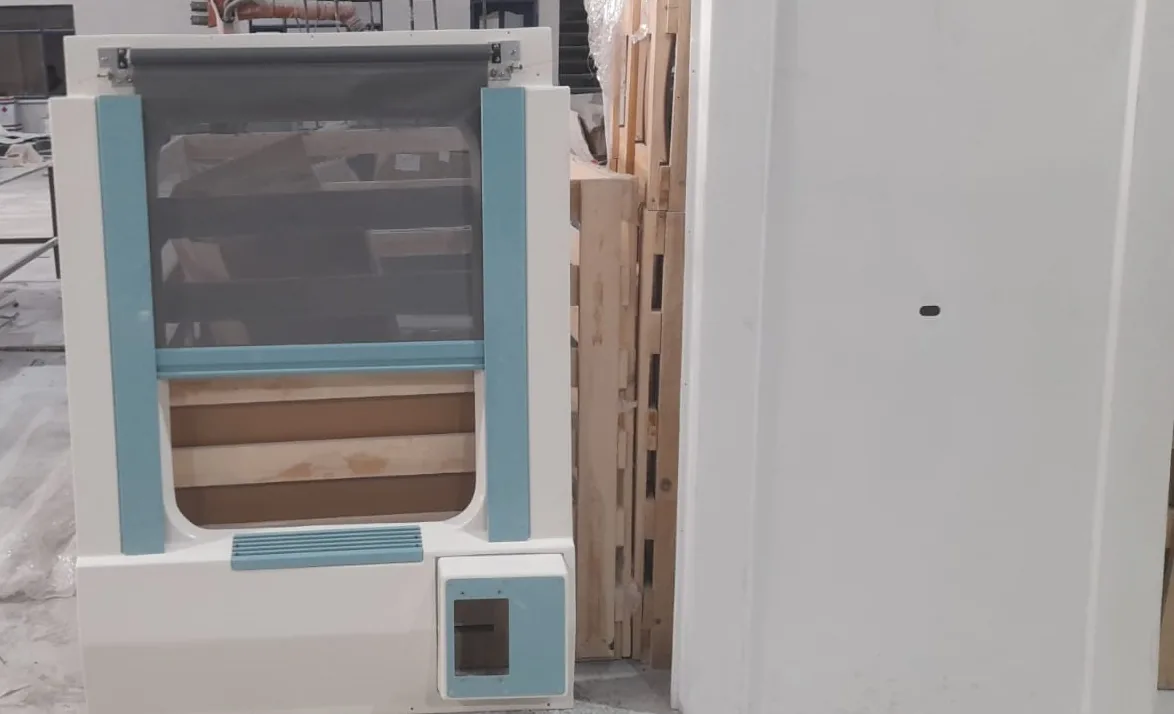
A sandwich composite places a light core material between two thin, high-strength skins. The idea delivers one of the most efficient weight savings in engineering.
Why It Works — The I-Beam Principle
When a beam bends, the top surface goes into compression and the bottom into tension, while the neutral axis in the middle sees almost no stress. A steel I-section is shaped exactly for that reason.
A sandwich composite applies the same logic to a surface: it keeps the strong material (laminate) on the outside and fills the middle with something light. The result is dramatic — because bending stiffness scales with the cube of thickness, doubling the core thickness increases stiffness roughly eightfold while adding only a few percent to weight.
| Structure | Relative thickness | Relative bending stiffness | Relative weight |
|---|---|---|---|
| Single-skin laminate | 1 | 1 | 1 |
| Sandwich (core = skin thickness) | 3 | ~7 | ~1.03 |
| Sandwich (core = 3× skin) | 5 | ~37 | ~1.06 |
The core's job is not to carry bending load but to hold the two skins a fixed distance apart and transfer the shear stress between them.
Core Material Types
Cross-linked PVC foam
The most widely used marine core. Available from 40 to 250 kg/m³, it absorbs no water, offers good shear strength and impact toughness, and can be thermoformed. It is the default for hulls, decks and superstructures.
SAN foam
Similar to PVC but tougher and with better temperature resistance. Used for racing boats and high-performance structures where impact absorption is critical.
PET foam
Made from recycled PET and fully recyclable. Good temperature resistance at moderate cost. Spreading quickly in wind energy and marine work because of sustainability targets.
Balsa
Natural, used end-grain so the fibres run through the thickness. Compressive strength exceeds most foams and cost is low. However it absorbs water — drill a hole without proper sealing and it will wick moisture and rot. Careful detailing is essential wherever deck hardware penetrates the core.
Honeycomb
Hexagonal cell structure in Nomex (aramid paper) or aluminium. It gives the highest stiffness per unit weight and is the aerospace standard. It is expensive and requires closed-mould techniques so it does not fill with resin.
| Core | Density | Water uptake | Cost | Typical use |
|---|---|---|---|---|
| PVC foam | 60–200 kg/m³ | None | Moderate | Hulls and decks |
| SAN foam | 60–200 kg/m³ | None | High | Racing boats |
| PET foam | 80–200 kg/m³ | Very low | Moderate | Wind blades, marine |
| Balsa | 100–250 kg/m³ | Yes | Low | Decks, bulkheads |
| Nomex honeycomb | 30–130 kg/m³ | None | Very high | Aerospace, racing |
Weak Points of Sandwich Construction
- Delamination: if the bond between skin and core is inadequate, the structure loses its function entirely. Cores are therefore supplied scored or perforated so resin can key into them.
- Local crushing: point loads (hardware, foot traffic) crush the core. The remedy is to remove the core locally and replace it with a solid insert.
- Water ingress: every penetration is a risk. Correct practice is to rout out the core around the hole and fill it with resin.
- Fire behaviour: organic cores are combustible. In public transport and marine interiors, fire classification must cover the entire structure.
Relationship to Production Method
Sandwich structures are produced most efficiently by vacuum infusion: the vacuum both presses the skins onto the core and distributes resin in a single shot. Alternatively, pre-cured skins can be bonded to the core with structural adhesive, but this gives a weaker bond.
Sandwich construction is also common in rail interior panels, for weight saving as well as acoustic and thermal insulation. Zenginler İmalat uses this approach in train interior panels and ceiling modules.