
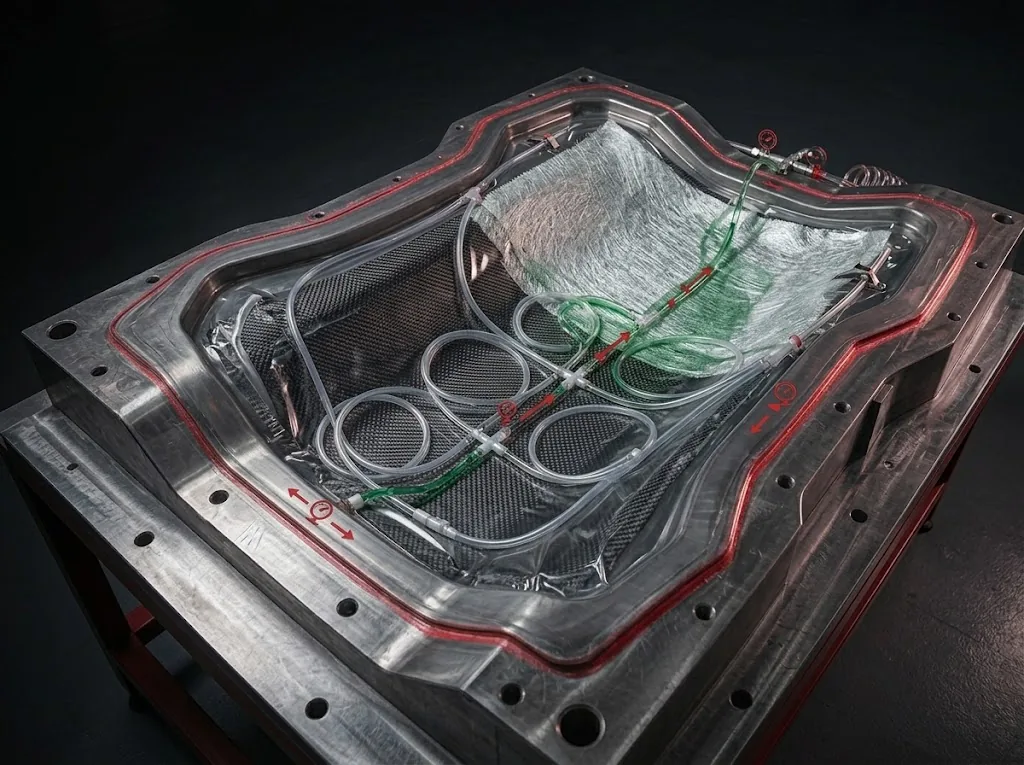
Vacuum infusion (VARTM — Vacuum Assisted Resin Transfer Moulding) is a closed-mould process in which dry reinforcement is sealed under a vacuum bag and resin is drawn into the laminate by the difference between atmospheric pressure and the vacuum inside.
The method has been applied worldwide since the 1980s, first in the United States, and is today the de facto standard for large composite parts — yacht hulls, wind turbine blades, train and truck bodies.
The Basic Idea
In open hand lay-up, resin is brushed and rolled into the laminate. How much resin goes in is decided by the laminator's hand; the excess stays in the part and air bubbles can never be fully removed.
In vacuum infusion the dry laminate is placed under vacuum. Pressure inside the bag falls close to absolute zero while 1 atmosphere pushes from outside. That difference produces roughly 1 bar — about 10 tonnes per square metre — of compaction and simultaneously draws the resin through the stack. No excess resin, no trapped air.
Process Steps
- Mould preparation: the mould is cleaned, release agent applied and, if required, gelcoat sprayed and allowed to gel.
- Dry lay-up: all fabric plies and any core material are placed dry, according to the ply book. There is no time pressure here — the resin is not yet involved.
- Consumables: peel ply, flow media and spiral resin distribution channels are laid on top.
- Bagging: the vacuum bag is sealed to the mould with tacky tape; inlet and vacuum ports are fitted.
- Drop test: vacuum is pulled and the pump isolated. Pressure loss must stay within limits. Skip this step and the infusion stalls halfway, scrapping the part.
- Infusion: the resin valve is opened and resin advances through the laminate; the flow front is watched.
- Cure: once the stack is fully wetted the inlet is closed and vacuum is held through cure.
- Debag and post-cure: consumables are stripped; an oven post-cure follows where required.
Advantages
- High fibre content: fibre volume fraction rises from the 25–35% of hand lay-up to 55–70%. Since the fibre carries the load, this translates directly into performance.
- Void-free laminate: resin fills every space under vacuum. Void content falls below 1%, against up to 5% in hand lay-up.
- Repeatability: the result is largely independent of the operator's skill. The same lay-up gives the same laminate every time.
- Weight saving: no excess resin is carried, so the same strength comes at lower mass.
- Very low styrene emission: resin travels inside a sealed system — decisive for both ISO 45001 and ISO 14001.
- Large parts: components metres in size can be produced in a single shot; a single-sided mould is enough and it need not be especially strong.
- Ideal for sandwich: vacuum presses the skins onto the core and produces an excellent bond.
Challenges
- Zero leak tolerance: a single hole in the bag puts the whole part at risk — hence the drop test.
- Resin viscosity is critical: a low-viscosity, long gel time infusion resin is required.
- Flow planning: where the resin enters and where it exits must be designed in advance; poor planning leaves dry spots.
- Consumable waste: bag, flow media and peel ply are discarded every cycle.
- One finished face: only the mould side is smooth. For two finished faces you need RTM.
Where It Is Used
Vacuum infusion is used for complex-shaped parts, in yacht construction, in train and truck body building and in wind turbine blades. It has also spread among small and medium builders producing sandwich composite leisure craft.
Vacuum Infusion at Zenginler İmalat
Zenginler İmalat applies vacuum infusion to large and high-performance parts: yacht and boat hull components, rail panels, automotive body parts and machinery cladding. The low-emission nature of the process aligns directly with our ISO 14001 and ISO 45001 commitments. More about our vacuum infusion service.