
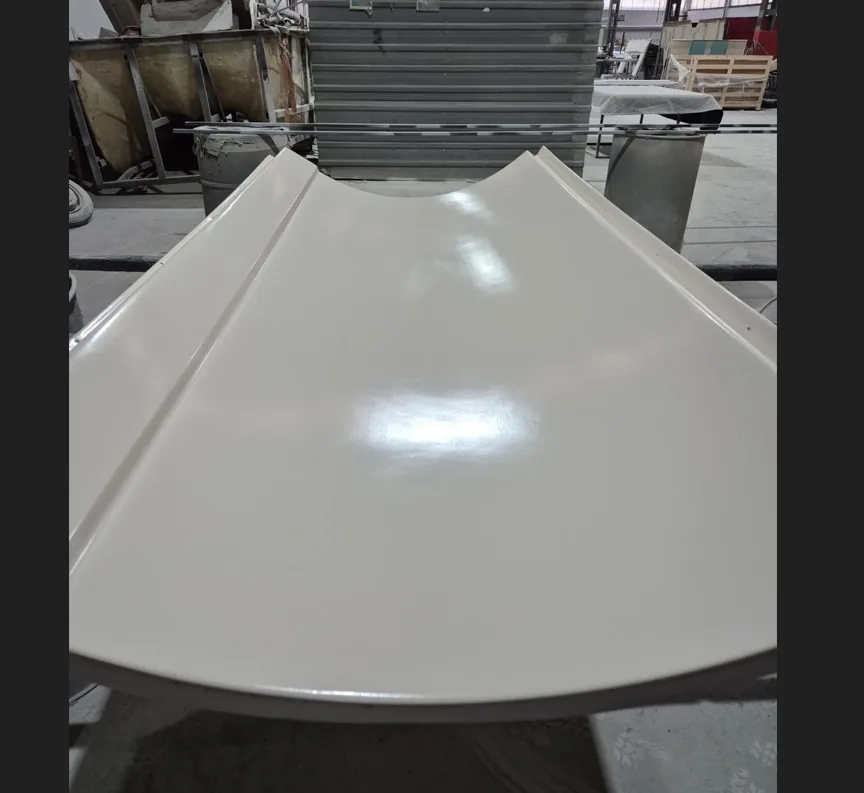
GRP stands for Glass Reinforced Polyester (also Glass Reinforced Plastic). It is the composite material obtained by reinforcing unsaturated polyester resin with glass fibre, and it is by far the most widely used composite in industry.
A Note on Terminology
The same material goes by different names depending on country and sector. The differences are linguistic, not technical:
| Term | Expansion | Note |
|---|---|---|
| GRP | Glass Reinforced Plastic / Polyester | Standard in the UK and Europe |
| Fibreglass | — | Common usage; strictly the name of the fibre itself |
| GFRP / FRP | (Glass) Fibre Reinforced Plastic | US and academic literature |
| CTP | Cam elyaf Takviyeli Polyester | Standard industry term in Türkiye |
| GFK | Glasfaserverstärkter Kunststoff | German-speaking countries |
If a specification says "GRP boat hull" or "CTP boat hull", it means the same thing.
What GRP Is Made Of
GRP has two principal raw materials: unsaturated polyester resin and glass fibre, plus gelcoat, fillers, pigments and additives according to need.
Glass fibre types
- E-glass: developed for electrical insulation; the most common and most economical. The great majority of GRP is made with E-glass.
- C-glass: high chemical resistance, used in the surface veil of tanks and pipes.
- S / R-glass: high strength, for aerospace and defence.
- AR-glass: alkali resistant, for concrete reinforcement.
Reinforcement forms
- CSM (chopped strand mat): randomly oriented short fibres. Cheap, conforms easily to the mould, direction-independent. The staple of hand lay-up.
- Woven roving: heavy woven fabric; builds thickness quickly and is stronger than CSM.
- Multiaxial fabrics (biaxial, triaxial): fibres stitched in flat layers rather than woven. With no crimp, they give the highest strength — the choice for infusion and yacht hulls.
- Continuous roving: for pultrusion and filament winding.
Properties
A typical hand lay-up GRP laminate (30% fibre) against structural steel:
| Property | GRP (hand lay-up) | Structural steel |
|---|---|---|
| Density | ~1.5–1.8 g/cm³ | 7.85 g/cm³ |
| Tensile strength | ~100–200 MPa | ~400 MPa |
| Specific strength | High | Moderate |
| Corrosion | None | Rusts unprotected |
| Thermal conductivity | Very low (insulating) | High |
| Electrical conductivity | Insulating | Conductive |
Strength rises sharply with fibre content. The 25–35% typical of hand lay-up becomes 55–70% in vacuum infusion — roughly double the strength at the same thickness.
Where GRP Is Used
- Marine: boat and yacht hulls, decks, superstructures. The vast majority of series-built boats worldwide are GRP.
- Rail: interior panels, ceiling modules, WC cubicles, water tanks, window frames.
- Water and chemicals: GRP pipe, storage tanks, treatment units, stacks.
- Automotive and agricultural machinery: bodywork, cab panels, deflectors, mudguards.
- Construction: facade panels, gratings, rooflights, walkways.
- Energy: transformer kiosks, cable ducts, wind turbine components.
Weak Points
Like any material, GRP has limits: risk of local delamination under impact, surface dulling under UV (addressed with gelcoat and paint), loss of performance above 80–100 °C, and difficult recycling. Combustibility is a design parameter — with flame-retardant resin and gelcoat, the strictest fire standards can be met.
Recycling
Being thermoset, GRP cannot be melted and reformed. Current approaches are mechanical grinding (reuse as filler), co-processing in cement kilns (recovering both energy and raw material) and developing solvolysis and pyrolysis routes. In Europe, cement co-processing is today the most widespread industrial solution.