
Measuring quality in a metal part is relatively easy: there is a material certificate, dimensions can be gauged, welds can be X-rayed. In composites the situation is different.
A composite part is manufactured together with its material. Resin ratio, fibre orientation, cure temperature, lamination sequence — all are set at the moment of production and all affect final performance. Worse, most of them cannot be judged from the finished part. A laminate that looks flawless from outside may contain 5% voids.
That is why management system certificates carry more weight in composites than in many other sectors. Here the certificate is not wall decoration; it is the mechanism that guarantees what cannot be seen.
ISO 9001:2015 — Quality Management
ISO 9001 is the quality management standard for organising a company's activities in a more orderly and systematic way. In composite manufacturing its meaning is very concrete:
- Recipe control: which resin, which catalyst ratio, which reinforcement, in which sequence. The recipe is approved and every change is recorded. In a laminate carrying a fire classification, recipe drift means the certificate becomes invalid.
- Raw material traceability: lot number, delivery date and shelf life of every batch of resin and gelcoat are recorded. If a problem appears, it is possible to trace back which batch produced which parts.
- Process parameters: ambient temperature and humidity, gel time, vacuum pressure and hold time, cure temperature. In composites a 5 °C difference in ambient temperature can double gel time.
- Mould maintenance records: the condition of the mould surface transfers directly to the part. Cycle count and polishing history are tracked.
- Nonconformity and corrective action: defective parts are recorded, root cause is sought and a preventive measure is defined, so the same fault does not recur.
- Personnel competence: in hand lay-up and infusion especially, the result depends on the operator, so training and competence records are kept.
ISO 14001:2015 — Environmental Management
In manufacturing, ISO 14001 ensures production is carried out more soundly through every stage from raw material to end user. Composite work has clear environmental loads that need managing:
- Styrene (VOC) emission: the largest environmental impact of open hand lay-up. Moving to closed-mould processes — vacuum infusion and RTM — is the single most effective improvement under ISO 14001.
- Waste management: uncured resin, used acetone, vacuum bagging, peel ply and fibre offcuts each fall under a different waste code and are managed separately.
- Dust control: extraction systems for glass fibre dust released during cutting and sanding.
- Scrap reduction: optimising fabric nesting delivers both environmental and economic gains.
ISO 45001:2018 — Occupational Health and Safety
ISO 45001 is regarded as indispensable in higher-risk sectors such as construction, mining, energy, manufacturing and chemicals. A composite shop falls squarely into that description:
- Styrene exposure: inhalation exposure limits are monitored; ventilation and PPE are mandatory.
- Peroxide (MEKP) safety: direct contact between MEKP and cobalt accelerator causes a violent reaction. Segregated storage and clear work instructions are vital.
- Glass fibre contact: skin irritation and respiratory risk; appropriate gloves, coveralls and masks.
- Fire risk: resins and solvents are flammable. Curing is exothermic, and an uncontrolled thick laminate can ignite.
- Ergonomics: extended stooped work over large moulds creates musculoskeletal risk.
Running All Three Together
Since 2015 these three standards share a common high-level structure (Annex SL). Clause numbering, terminology and the risk-based approach are now aligned, which makes an integrated management system (IMS) both possible and sensible.
Integration matters for organisations in manufacturing, logistics, energy and construction where quality, environmental and safety risks are all high. The concrete gains:
- One documentation set, one internal audit programme, one management review
- Lower certification and audit costs
- Legal compliance monitored from a single point
- Preference in tender processes
- Stronger corporate standing
In composites specifically, integration creates a natural overlap: moving to closed moulding improves quality (ISO 9001 — repeatability), environment (ISO 14001 — VOC reduction) and safety (ISO 45001 — exposure reduction) simultaneously. One investment serves the objectives of all three standards.
An ISO Certificate Is Not a Product Certificate
A frequently confused point: ISO 9001 certifies the process, not the product. A company can hold ISO 9001 while its product has no EN 45545-2 fire classification.
The correct arrangement is to have both. A product certificate proves the performance of that specimen; ISO 9001 guarantees that series production will remain identical to it. Without one, the other is incomplete.
Zenginler İmalat's Certificates
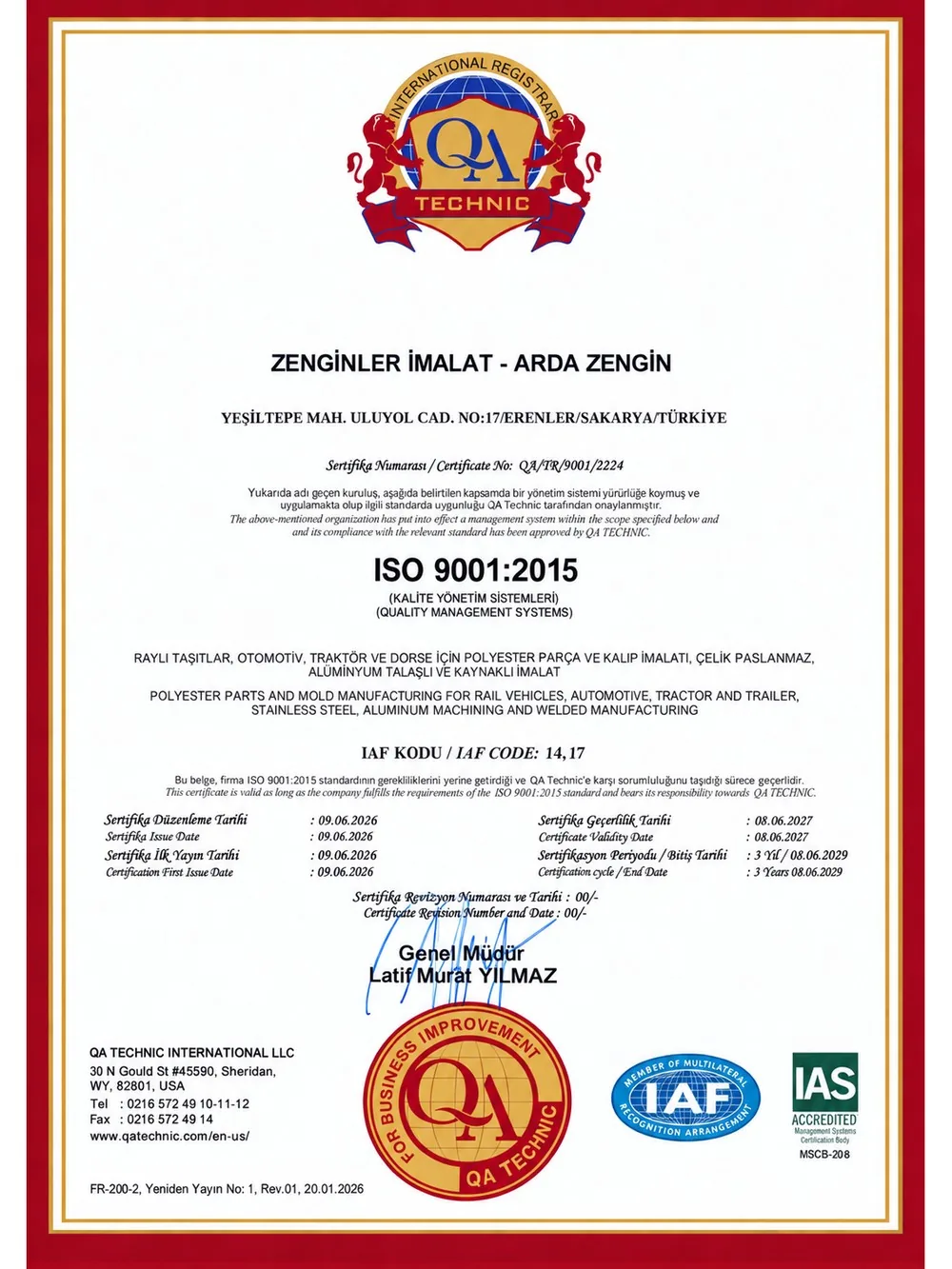
Zenginler İmalat applies all three management system standards in an integrated form, certified by QA Technic International:
| Standard | Scope | Certificate no. | Valid until |
|---|---|---|---|
| ISO 9001:2015 | Quality management system | QA/TR/9001/2224 | 08.06.2027 |
| ISO 14001:2015 | Environmental management system | QA/TR/14001/1697 | 08.06.2027 |
| ISO 45001:2018 | Occupational health and safety | QA/TR/45001/1189 | 08.06.2027 |
QA Technic International is accredited by IAS under MSCB-208; IAS is a signatory to the Global Accreditation Cooperation (Global ACI) Multilateral Recognition Arrangement. The certificates are subject to annual surveillance audits.
On the product side there is also a TS EN 45545-2:2023 reaction-to-fire classification report (no. 304218) issued by TSE. All documents can be reviewed on our Management Systems page.