
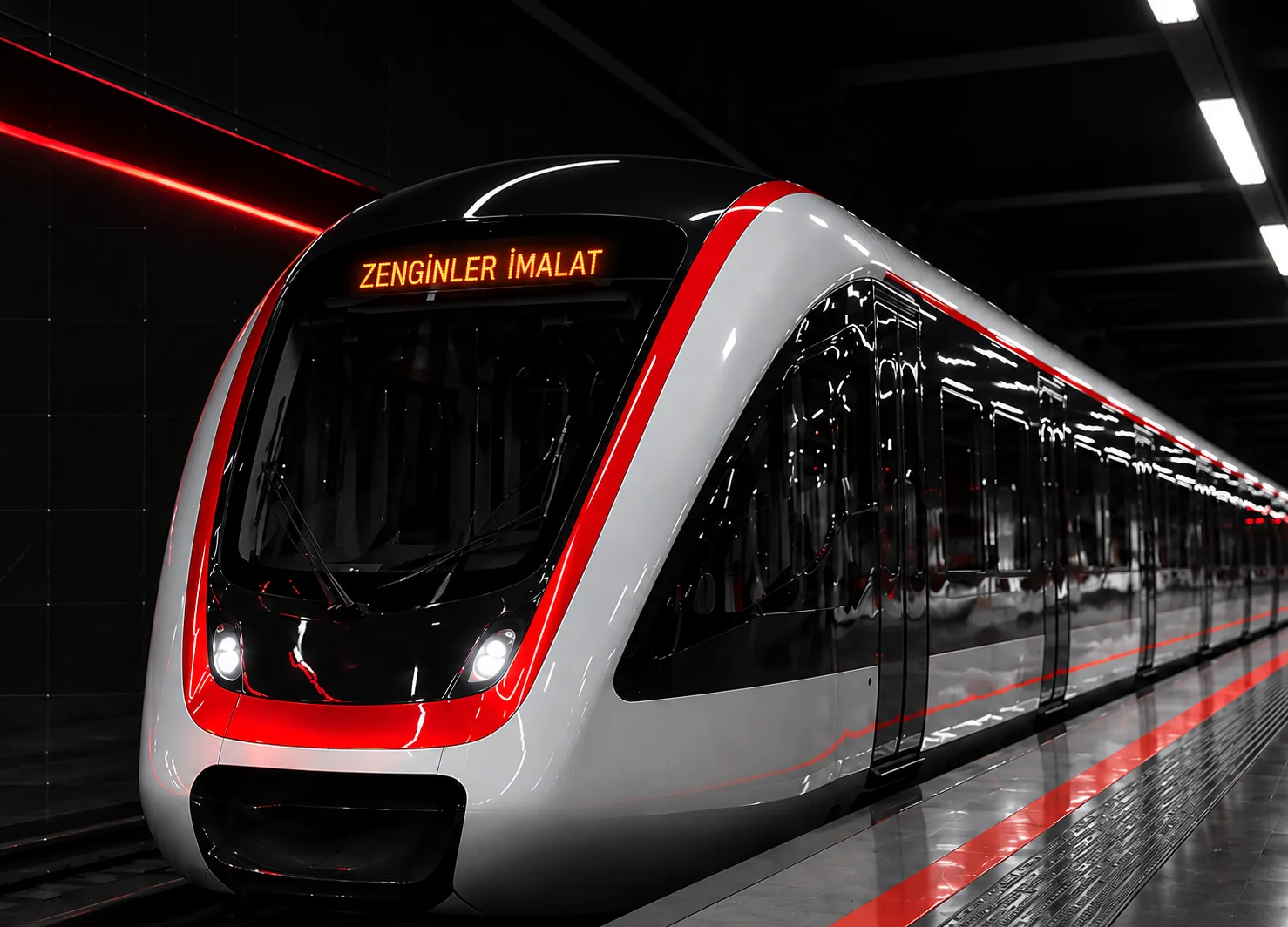
EN 45545-2 is the European standard titled "Railway applications — Fire protection on railway vehicles — Part 2: Requirements for fire behaviour of materials and components". In Türkiye it is applied as TS EN 45545-2; the current edition is 2023.
The standard replaced a fragmented landscape in which each country applied its own national rule (DIN 5510 in Germany, NF F 16-101 in France, BS 6853 in the UK) and became the mandatory single framework across Europe. All materials used in rail vehicle manufacture must follow it in order to reach the highest possible level of safety in the event of fire.
The Logic: Three Layers of Classification
EN 45545-2 is not a single pass/fail test. It asks three questions in sequence:
- Where is the material used? → Requirement set (R)
- What kind of line does the vehicle run on? → Operation and design category
- How high is the resulting risk? → Hazard level (HL)
1. Requirement Sets (R Sets)
The standard defines a separate requirement set for each location inside the vehicle. There are 26 in total (R1–R26); the most commonly used are:
| Set | Surfaces / components covered |
|---|---|
| R1 | Interior vertical and horizontal surfaces — wall panels, ceilings, window frames, driver desks, gangway interiors |
| R2 | Interior components whose mechanical properties are decisive |
| R6 | Seat covers and upholstery textiles |
| R7 | Floor coverings |
| R10 | Cables |
| R17 | Exterior surfaces |
R1 is the critical set for composite panel manufacturers, because most visible surfaces inside a train interior fall within it.
2. Operation and Design Categories
The operation category describes how difficult evacuation is:
- OC1: lines where passengers can leave the vehicle easily and walk to a safe area.
- OC2: lines with restricted evacuation.
- OC3: long tunnels and elevated structures — evacuation is difficult.
- OC4: underground metro systems — the most difficult evacuation condition.
The design category describes vehicle type: DC1 (automatic, unstaffed), DC2 (standard vehicle), DC3 (double deck), DC4 (sleeping or couchette vehicle).
3. Hazard Levels (HL1, HL2, HL3)
The intersection of operation and design category gives the hazard level. There are three:
- HL1 — lowest requirement. Open lines where evacuation is straightforward.
- HL2 — medium risk. Most intercity and regional lines.
- HL3 — highest requirement. Underground metro, long tunnels, sleeping vehicles.
A material meeting HL3 may by definition be used in every application requiring HL2 and HL1. For a manufacturer, an HL3 classification therefore means the widest possible market access.
Parameters Measured
| Parameter | Test method | What it measures | R1 HL3 limit |
|---|---|---|---|
| MARHE | ISO 5660-1 | Maximum average rate of heat emission | ≤ 60 kW/m² |
| Ds(4) | EN ISO 5659-2 | Smoke optical density at 4 minutes | ≤ 150 |
| VOF₄ | EN ISO 5659-2 | Cumulative smoke production | Set dependent |
| CITG | EN 45545-2 Annex C | Gas toxicity index | ≤ 0.75 |
| CFE | ISO 5658-2 | Critical flux at extinguishment | ≥ 20 kW/m² |
Many sets also carry an oxygen index (OI) requirement; an OI of at least 28% is required for HL1 and HL2 materials.
How Classification Works
- The manufacturer fixes the laminate recipe and produces specimens.
- Specimens go to an accredited laboratory.
- A separate test report is issued for each parameter (ISO 5658-2, ISO 5659-2, ISO 5660-1).
- These reports are combined into a classification report declaring which HL levels are met in which R set.
- In series production the recipe must not change — which is where ISO 9001 recipe control enters.
Important: a test report does not replace a product certificate. It contains measurements made on specimens delivered to the laboratory; keeping series production identical is the manufacturer's responsibility.
Zenginler İmalat's EN 45545-2 Classification
Zenginler İmalat's painted glass fibre reinforced laminate was assessed by the TSE Construction Materials Fire and Acoustics Laboratory under TS EN 45545-2:2023 and found compliant in requirement set R1 at hazard levels HL1, HL2 and HL3 — all three (classification report no. 304218, issued 23.09.2024).
The classification covers the following locations: interior vertical surfaces, interior horizontal downward-facing surfaces, interior surfaces inside cavities, exterior surfaces of enclosures containing technical equipment, luggage storage areas, driver desks, gangway interiors, window frames, tables, waste bins, air ducts (interior and exterior surfaces), passenger information devices and the undersides of couchettes.
The laminate tested: ~3.12 mm thick, 4.88 kg/m² mass per unit area; Büfa Firestop GC S285-SV fire gelcoat, Büfa Firestop 8175-W-1 flame-retardant resin with Şişecam glass fibre, plus flame-retardant acrylic-polyurethane primer and topcoat.
The measured values are all below the HL3 limits: MARHE 59.73 kW/m² (limit 60), Ds(4) 101.13 (limit 150) and CITG 0.68 (limit 0.75). The full report can be downloaded from our Management Systems page.