
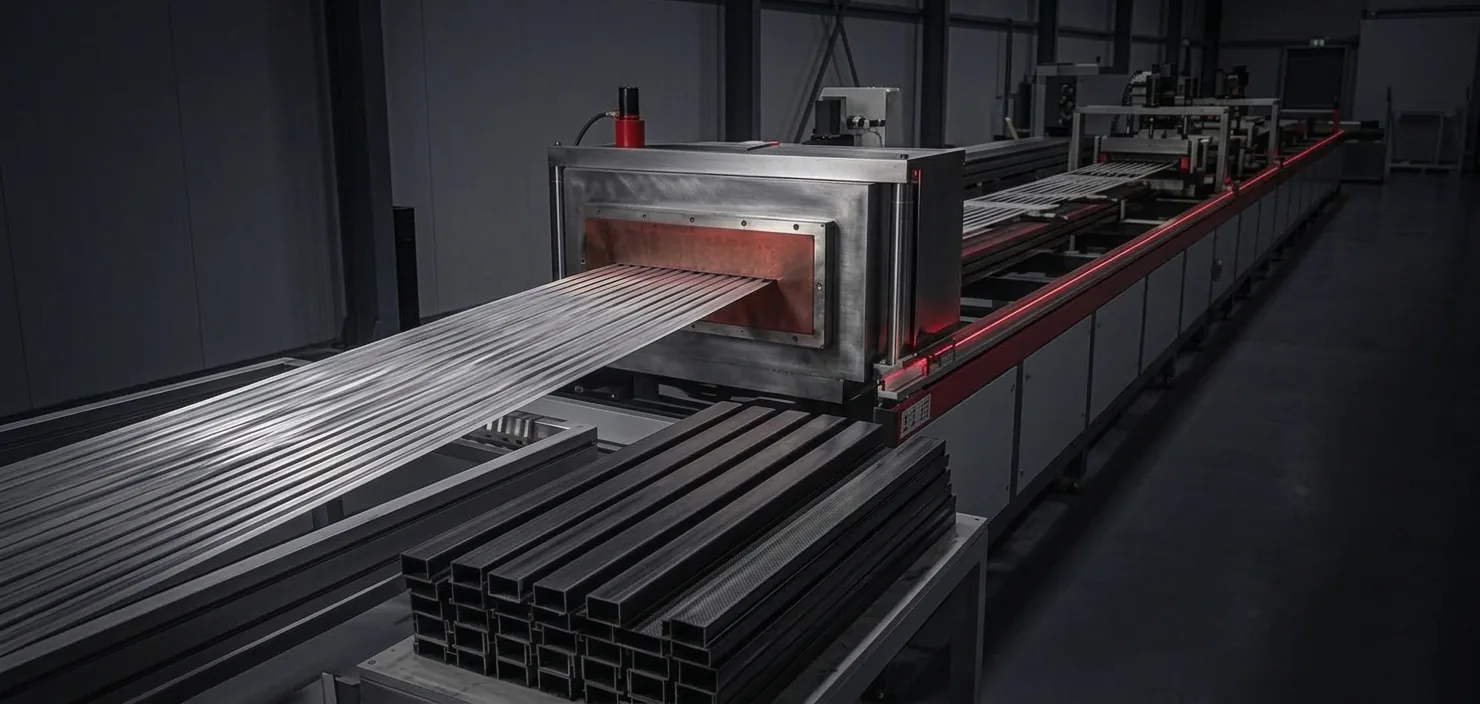
Pultrusion is a manufacturing process in which continuous glass roving, woven roving or mat is drawn through a thermoset resin bath and then through a heated steel die, where it cures into a defined cross-section.
The name combines pull and extrusion. In extrusion, material is pushed through the die; in pultrusion it is pulled — and what does the pulling is the fibre itself.
How the Process Runs
- Creel: hundreds of glass roving bobbins feed continuous fibre into the line.
- Resin impregnation: the fibres pass through a polyester, vinylester or epoxy bath. Modern lines impregnate in a closed injection box at the die entry, for lower emission.
- Preforming: guide plates bring the wetted fibre bundle close to the final section and strip excess resin.
- Heated die: the profile passes through a heated steel die 60–120 cm long, where the resin cures and the section is permanently fixed.
- Pulling: caterpillar or hydraulic pullers draw the profile out at constant speed.
- Cut-off: a flying saw cuts the profile to length without stopping the line.
Line speed
Typical line speed is 0.6–1.2 metres per minute, rising to 3 m/min for suitably shaped sections.
Advantages
- Continuous and automated: a low-labour, fully automatic process. One line runs uninterrupted through the shift.
- Highest fibre content: 60–70%, aligned in the pull direction, giving exceptional longitudinal strength.
- Constant quality: section and mechanical properties do not vary along the length.
- Unlimited length: the profile can be cut to any length within transport constraints.
- Low unit cost: at sufficient metreage, cost per metre is very low.
- Corrosion and insulation: GRP profile does not rust, does not conduct electricity and is not magnetic.
Limits
- Constant section only: the cross-section cannot change along the length. Tapered or variable sections are impossible.
- Low transverse strength: with fibres aligned longitudinally, transverse properties are weak; mat layers partly compensate.
- Tooling investment: each section needs its own steel die, so small metreages are uneconomical.
Profile Types and Applications
| Profile | Application |
|---|---|
| I, U, L and box sections | Load-bearing structures, platforms, handrails |
| Grating bars | Walkways, catwalks, treatment plants |
| Tube and rod | Poles, cable carriers, electrical insulation |
| Custom sections | Window frames, door frames, panel carriers |
| Cable trunking | Energy and rail infrastructure |
Pultruded profiles replace steel especially where electrical insulation is needed and where the environment is corrosive: treatment plants, coastal structures, chemical facilities, power distribution infrastructure and rail platforms.
Pultrusion at Zenginler İmalat
Zenginler İmalat integrated pultrusion in 2015. Today GRP profiles for energy, construction and rail applications are produced on this line. More about our pultrusion service.