
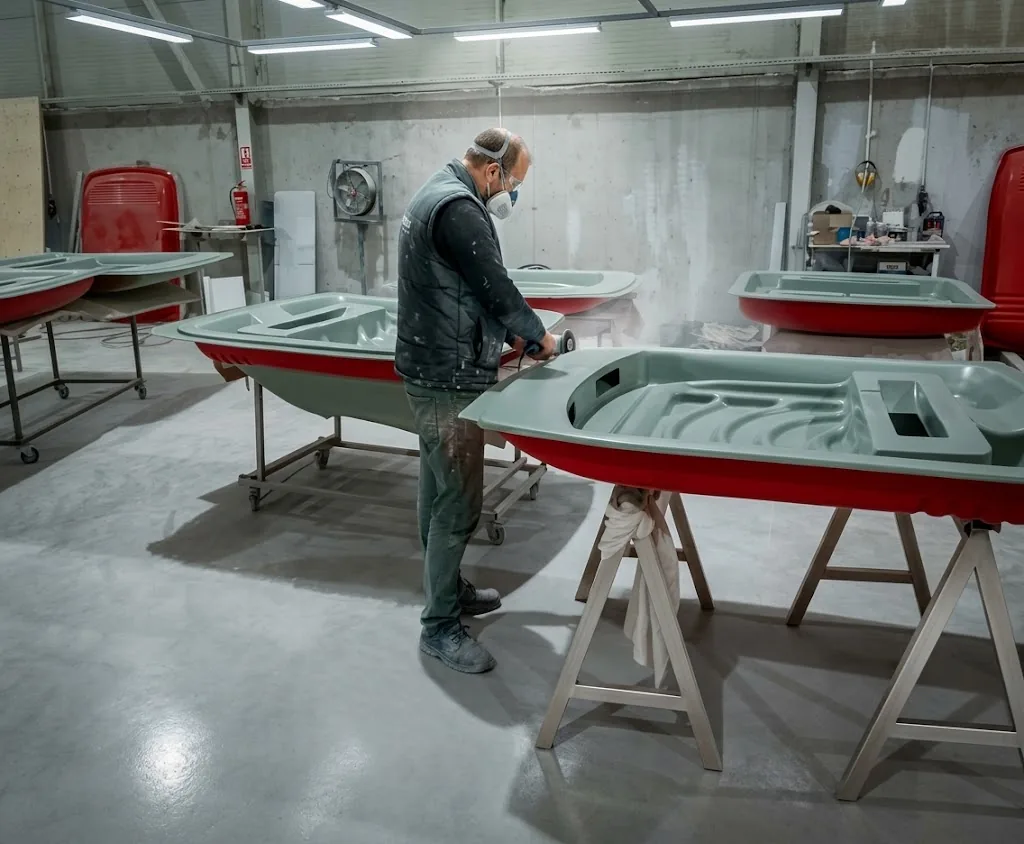
The great majority of series-built boats and yachts in the world are made from GRP. The reason is straightforward: composite does not corrode, it produces complex hull forms in a single piece, and it needs far less maintenance than timber or steel.
This article walks through the real production sequence of composite boat building, from design to launch.
1. Design and Engineering
Everything starts with the hull lines and the structural calculation. Determined at this stage:
- Hull form, displacement and stability calculations
- The laminate schedule (ply book): how many plies where, which fabric, which orientation
- Where the structure is single-skin and where it is sandwich
- Class society requirements (CE category, ISO 12215 scantling rules)
- Layout of bulkheads, stringers and the structural grid
A boat sees very different loads in different areas. The forward bottom panel that slams into waves carries the thickest laminate; the topsides are usually cored to save weight.
2. Plug Making
The mould cannot be made directly. First a full-size positive model of the boat — the plug — is produced. It is CNC-machined from foam or MDF blocks, filled, faired and polished to a mirror finish.
The critical point: every flaw in the plug transfers to the mould, and every flaw in the mould transfers to every boat built from it. This is why fairing the plug is one of the most labour-intensive stages of the whole process.
3. Mould Making
Release agent is applied to the plug, followed by tooling gelcoat (harder and more abrasion resistant than part gelcoat) and a thick GRP laminate. The mould is supported with a steel frame so it will survive hundreds of production cycles.
Large hulls need a split mould — otherwise the boat cannot be released. Once pulled, the mould surface is polished and inspected again.
4. Mould Preparation and Gelcoat
- The mould surface is cleaned and polished.
- Release agent (wax, semi-permanent release or PVA) is applied. Skip this and both the boat and the mould are lost.
- Gelcoat is sprayed to 0.5–0.8 mm. Isophthalic-NPG is standard on hulls.
- The gelcoat is left until it gels to a tack-free state.
5. Skin Coat and Barrier Layer
A fine surface tissue and CSM layer is applied by hand, very carefully, directly onto the gelcoat. Its purpose is to prevent air entrapment between gelcoat and laminate, and to stop the fabric weave printing through to the surface.
In quality production this area is laminated in vinylester resin as a second barrier against water ingress. This detail, more than any other, determines whether the boat develops osmosis twenty years later.
6. Hull Lamination
The main structure is built here, by one of two routes:
Hand lay-up
Fabric plies are laid into the mould and resin is worked in with roller and brush; air bubbles are driven out with a grooved roller. Flexible and low-investment, but fibre content stays at 25–35%, excess resin adds weight, and the result depends on the laminator's skill.
Vacuum infusion (VARTM)
All plies and the core are laid dry, sealed under a vacuum bag, the air is removed and resin is drawn into the laminate by vacuum. The result: 55–70% fibre content, a void-free laminate, repeatable quality and far lower styrene emission. This is the standard for serious yacht production today — details in our vacuum infusion article.
7. Structural Framework
The hull alone is a shell; stiffness comes from the internal framework:
- Longitudinal stringers — stiffen the hull fore and aft and distribute slamming loads.
- Transverse bulkheads — divide compartments and provide torsional stiffness.
- Engine beds — transfer thrust into the hull; one of the highest-stress regions.
- Grid system — a one-piece structural grid moulded separately and bonded into the hull, improving repeatability in series production.
These elements are bedded on structural adhesive and tabbed over with laminate.
8. Deck and Superstructure
The deck is moulded in its own tool, usually as a sandwich because bending stiffness matters on a walking surface. Non-skid pattern is moulded directly into the tool.
9. Hull-to-Deck Joint
This is where boats most commonly leak. Correct practice is three-layered: mechanical fastening (rivets or bolts), structural adhesive (usually methacrylate or epoxy paste) and a laminate tape over the joint. Joints relying on silicone and screws alone begin to leak within a few seasons.
10. Fit-Out and Delivery
Engine, shaft or sterndrive, steering, electrics, plumbing, interior joinery and upholstery are installed. Stability testing, water testing and sea trials follow, and CE certification is completed.
Choosing the Process
| Boat type | Suitable process | Reason |
|---|---|---|
| One-off / custom build | Hand lay-up | Low tooling cost, high flexibility |
| Series day boat | Hand lay-up or infusion | Infusion gains as volume rises |
| Motor yacht / sailing yacht | Vacuum infusion | Weight and quality are critical |
| Racing boat | Prepreg / infusion (carbon) | Highest specific strength |
| Hatches, mouldings, small parts | RTM | Two finished faces, short cycle |
Türkiye's Position in Boat and Yacht Building
Türkiye is not a minor player here. According to the Ship, Yacht and Services Exporters' Association, the sector reached an all-time record of USD 2.243 billion in exports in 2025, a 17.4% increase that ranked it second in export growth after defence and aerospace. In mega yacht construction Türkiye has overtaken the Netherlands to rank second in the world after Italy.
Behind that growth sits a broad composite supply chain, from hull production to interior components.
Zenginler İmalat's Contribution
Zenginler İmalat brings its polyester and composite manufacturing experience — continuous since 1977 — to the yacht and boat sector. Hull components, deck hardware parts, mouldings, hatches and interior panels are produced by hand lay-up, vacuum infusion and RTM. All manufacturing runs under ISO 9001, ISO 14001 and ISO 45001 management systems.