
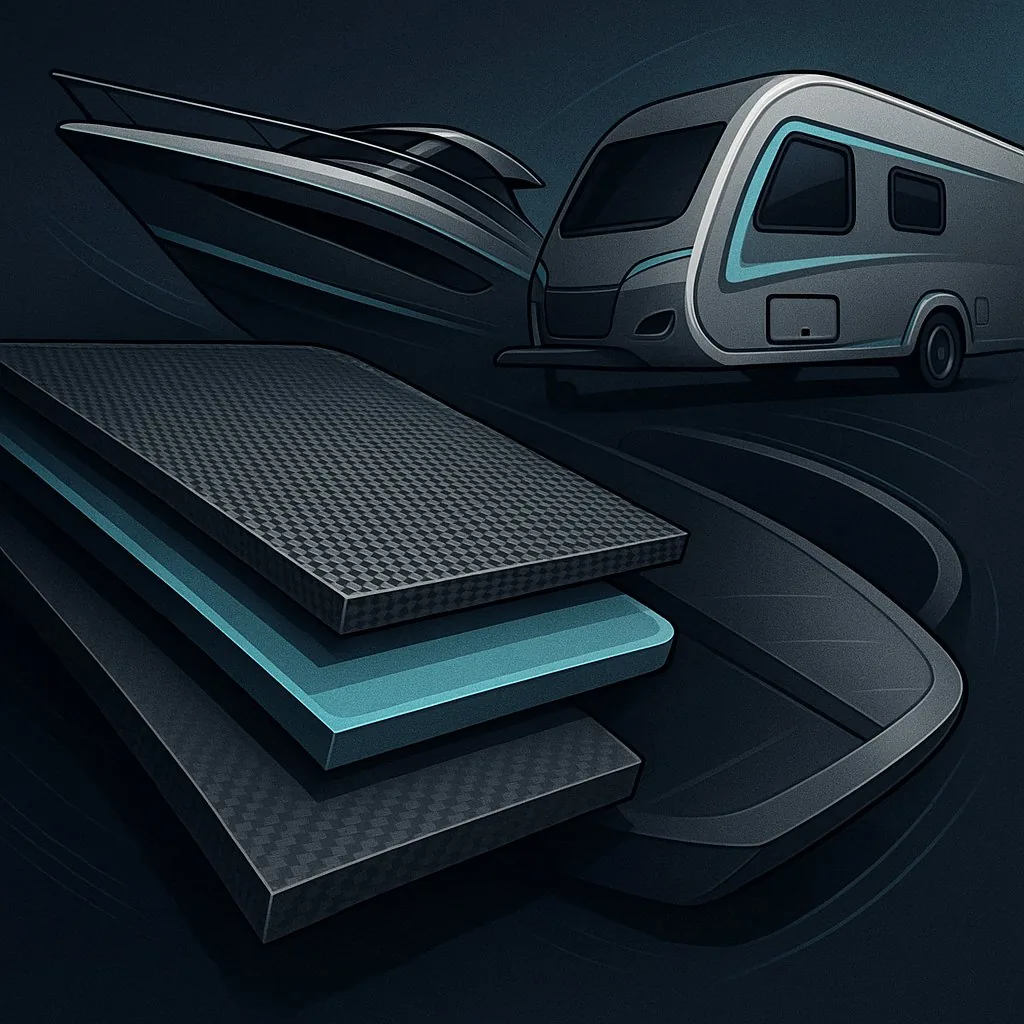
A yacht's material determines not only how it is built but what it costs over its life. Fuel consumption, maintenance, insurance and resale value all follow from the hull material.
This article compares composite in yacht building against steel, aluminium and timber on concrete criteria.
Material Comparison
| Criterion | Composite (GRP) | Aluminium | Steel | Timber |
|---|---|---|---|---|
| Density | 1.5–1.8 g/cm³ | 2.7 g/cm³ | 7.85 g/cm³ | 0.5–0.9 g/cm³ |
| Corrosion | None | Galvanic risk | High | Rot risk |
| Maintenance burden | Low | Moderate | High | Very high |
| Complex form | Unrestricted | Limited | Limited | Labour intensive |
| Series production | Very suitable | Difficult | Difficult | Unsuitable |
| Repair | Easy, by lamination | Requires welding | Requires welding | Requires a shipwright |
| Thermal / acoustic | Good | Poor | Poor | Good |
| Fire behaviour | Formulation dependent | Non-combustible (low melting) | Non-combustible | Combustible |
1. Weight — The Most Direct Effect
A composite hull of equal stiffness is significantly lighter than steel, with three consequences:
- Lower fuel consumption. Less displacement means less power for the same speed.
- Higher speed and better planing. A light boat gets onto the plane sooner.
- Greater payload. At the same displacement you can carry more fuel, water and equipment.
Combining vacuum infusion with sandwich construction widens the advantage further — up to 30% weight saving at the same laminate thickness.
2. Corrosion — An Entire Cost Line Removed
Sea water is the harshest test environment there is. A steel hull needs cathodic protection, regular paint and constant monitoring. In aluminium, every point where dissimilar metals meet is a galvanic corrosion risk.
Composite is electrochemically inert — it does not corrode. That removes a maintenance item repeated for the life of the vessel. The only thing to watch is osmosis, and with correct gelcoat and barrier practice that risk disappears in practice.
3. Form Freedom and Design
Much of a yacht's appeal comes from flowing, double-curvature surfaces. In sheet material every curve is a forming and welding operation; in composite the part is whatever shape the mould is. Radar arches, fly bridges, hard tops and swim platforms can all be moulded in one piece.
4. Series Production Economics
Once the mould exists, every boat repeats the same form. That lowers unit cost and guarantees consistency. It is the economic reason virtually every series yacht brand in the world builds in composite.
5. Interior Comfort
Composite conducts roughly one hundredth as much heat as steel. That means a cooler interior in summer, warmer in winter, lower air-conditioning load and less condensation. Sandwich construction also cuts engine and wave noise appreciably.
Where Composite Is Not the Answer
- Very large vessels: above roughly 50 metres, steel and aluminium remain economically superior — though composite superstructures are common even on mega yachts.
- Ice class and expedition boats: steel is preferred against ice loading.
- One-off builds: tooling investment cannot be justified for a single boat; aluminium or wood-epoxy may suit better.
- Fire: composite is combustible, so commercial passenger vessels must use materials certified under the IMO 2010 FTP Code.
Where the Sector Is Heading
The Turkish ship and yacht sector set a historic record of USD 2.24 billion in exports in 2025, and Türkiye now ranks second in the world after Italy in mega yacht construction. In January–April 2026, exports rose 103.8% against the same period of the previous year. That growth translates directly into demand for composite component suppliers.
Working with Zenginler İmalat
Zenginler İmalat manufactures hull components, deck and hardware parts, mouldings, hatch systems, hard tops and interior panels for yacht and boat builders. Because hand lay-up, vacuum infusion and RTM are all available in the same plant, the technically and commercially right process can be chosen for each part. Manufacturing runs under ISO 9001:2015, ISO 14001:2015 and ISO 45001:2018. Request a quote for your project.