
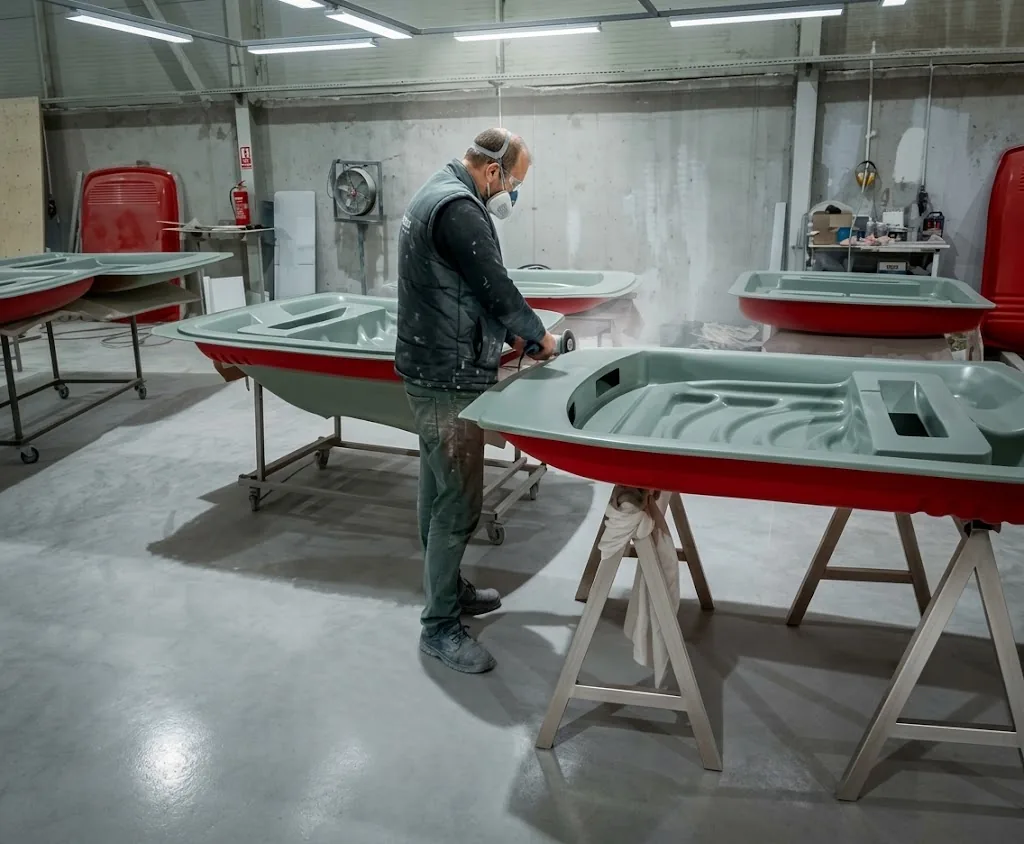
In composites, choosing the process matters as much as choosing the material. With the same resin and the same glass, the process alone can double the fibre content, cut part weight by a third and reduce emissions tenfold.
Four Processes, One Table
| Criterion | Hand lay-up | Vacuum infusion | RTM | Pultrusion |
|---|---|---|---|---|
| Tooling | One open mould | One mould + bag | Two rigid moulds | Heated steel die |
| Fibre content | 25–35% | 55–70% | 45–60% | 60–70% |
| Void content | 2–5% | <1% | <2% | <1% |
| Finished faces | One | One | Two | Full section |
| Part size | Small–very large | Small–very large | Small–medium | Constant section, any length |
| Tooling cost | Lowest | Low | High | Very high |
| Cycle time | Long | Long | Short | Continuous |
| Ideal volume | 1–50 | 5–500 | 200–50,000 | By metreage |
| Operator dependency | High | Moderate | Low | Very low |
| Styrene emission | High | Very low | Very low | Low |
Hand Lay-Up — The Flexible Route
The oldest and most widespread process. Fabric is laid into the mould and resin worked in by roller and brush. Investment is close to zero: a mould, rollers and ventilation.
Right when: one-off or very small series, prototypes, repairs, very large and complex parts, frequent design changes.
Wrong when: weight is critical, repeatability is mandatory, volumes are high, or occupational and emission limits are tight.
Our hand lay-up service →
Vacuum Infusion — The Large and Light Route
Dry laminate under vacuum, resin drawn in. Fibre content doubles and voids effectively disappear.
Right when: yacht and boat hulls, large panels, sandwich structures, anywhere weight is critical, and where low emission is mandatory.
Wrong when: parts are very small (consumables dominate) or two finished faces are required.
Vacuum infusion in detail →
RTM — The Series Route
Resin injected between two rigid tools. Two finished faces, short cycle, tight tolerance.
Right when: medium and high volumes, panels visible on both sides, tight dimensional tolerance, parts needing embedded inserts.
Wrong when: volume is low (tooling cannot amortise) or the part is very large.
RTM in detail →
Pultrusion — The Profile Route
Continuous fibre pulled through a heated die. Constant-section profiles at very low cost per metre.
Right when: beams, columns, grating bars, cable ducts, tubes, frames — any product whose section does not change.
Wrong when: the section varies or the metreage is small.
Pultrusion in detail →
A Four-Question Selection Guide
- Is the section constant along the part? If yes → pultrusion.
- How many will be made? More than a few hundred, and medium sized → RTM.
- Is the part large and is weight critical? If yes → vacuum infusion.
- Is it a one-off, a prototype or a highly variable job? If yes → hand lay-up.
The Shift from Open to Closed Moulding
The industry is moving from open to closed moulding, driven by three forces:
- Occupational and environmental regulation: styrene exposure limits keep tightening. Closed moulding makes ISO 45001 and ISO 14001 compliance far easier.
- Quality expectation: OEM customers no longer accept part-to-part variation.
- Weight targets: in both automotive and marine work, every kilogram carries a cost.
Why Having All Four Matters
Zenginler İmalat has practised hand lay-up since 1977, pultrusion since 2015 and RTM since 2016, alongside vacuum infusion — all in the same plant.
For a customer this means the part is not forced to fit a supplier's single capability: the process is chosen to suit the part. Different components within the same project can each be produced by the method best suited to them. All our production methods →